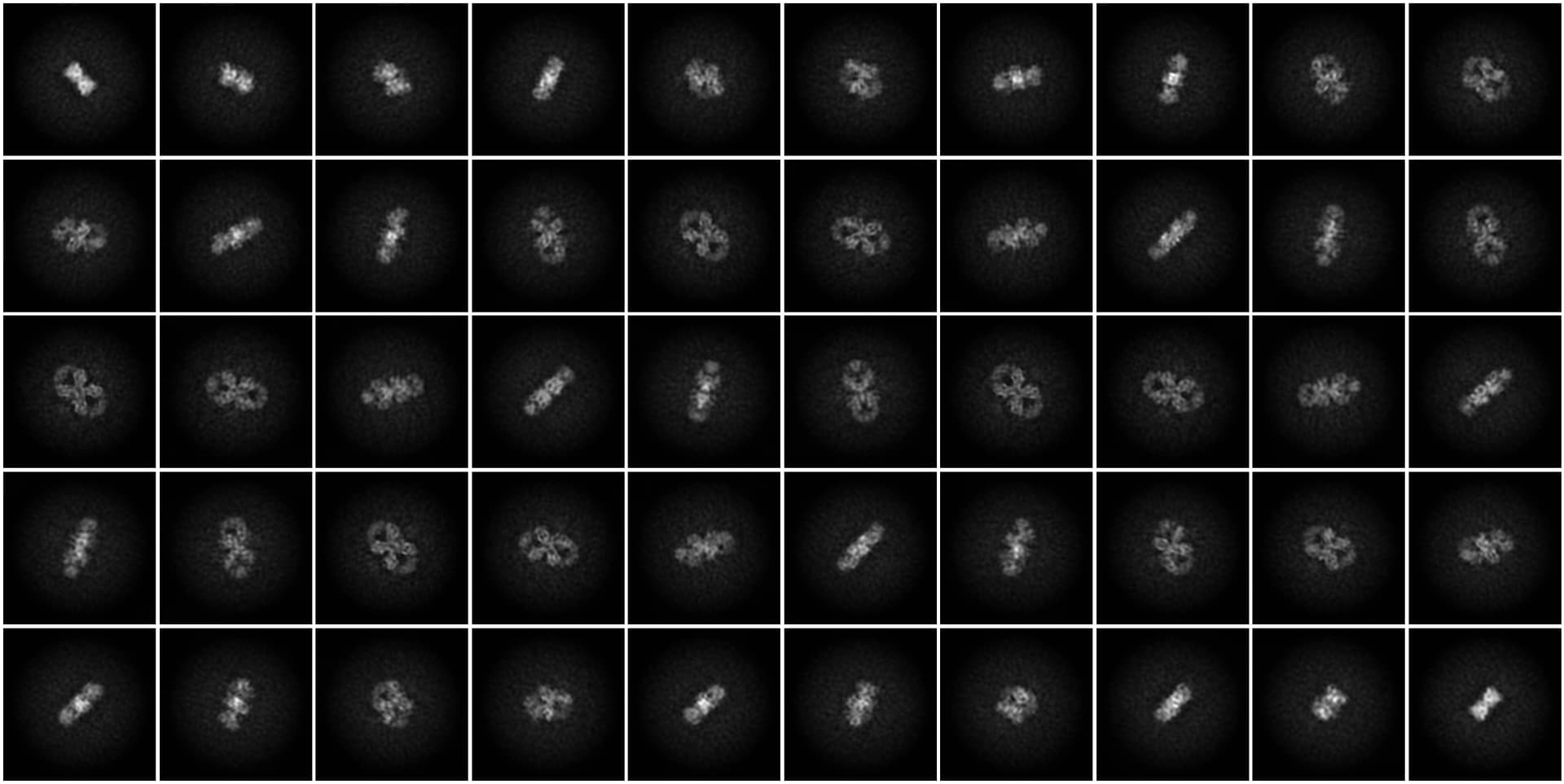
I somehow ran into an issue with 2D classification. In brief, my protein is composed of two rings that are similar in MW. I first did a template picking with the following templates and got ~2million particles:
However, as I did 2D classification, the top-ranked ones have fine structures with it, but the overall shapes are quite confusing. The class with the most particles seems like a pinwheel. The 2nd-4th classes seem more mono-dispersed, but still have some strange density attached to one side, plus, the top and bottom rings seem like mirror images of each other in some of the classes, which is not right.
There are good side views (the rod-shaped ones), and I suspect the strange patterns observed are caused by misalignment issues at an early stage of classification. The setting applied in this classification is as such: 120 classes, force-max OFF, 40 online EM-iterations, 400 batchsize, with the rest parameters by default. I also played with the number of classes (50-200), force-max on/off, number of final full iterations (1 or 10), and uncertainty factor (2, 5, 8). None of them helped break down the pinwheel or dirty classes.
If you map the pinwheel classes back to the micrographs, what do the particles look like? Do you see any hint of multimeric arrangements like you observe in the 2D classes?
Also, the classes do not make any sense if they are oligomers, since I cannot map the domains to the design of my protein. And in theory, larger oligomers should also form longer side views, which are never found as well.
Is it possible that your particle picks are off center such that a local minima is preferentially found sometimes where just half of the particles are aligned in this overlapped manner? I’ve seen similar things in very crowded micrographs and I wouldn’t worry about it too much. I would expect that this would disappear in 3D if larger oligomers don’t actually exist. You could try a slightly tighter mask and see if that helps or if they persist after a few rounds of 2D classification.
Thanks for your reply. A tight mask did improve the classification, but not too much. Also, the pinwheel was gone in 3D models, but some weak density would still extend from one side of my figure 8-shaped model after refinements, which seems like a precursor of a pinwheel. I just have a strong feeling that cryosparc is not good at dealing with this protein… I am planning to give Relion a try.
Looks like your particles are oligomerising into those hexameric pinwheels. Did you try 2D classification with particles extracted with a larger box to aid centring? And maybe trying template based picking using your 2D classes from your experimental data will help get more views along with better centring.