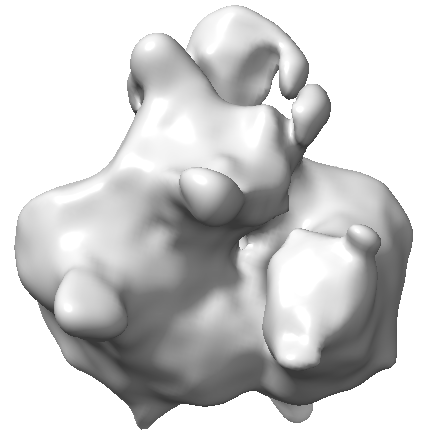
HR-HAIR works well, but NU Refinement is failing?

Hi CryoSPARC folks, I’m having trouble with getting good non-uniform refinement results. The HR-HAIR (i.e. Ab Initio) method proposed by @olibclarke gets me to a decent starting point, but when I switch to non-uniform refinement, things start falling apart. I’ll elaborate on the current workflow. Thank you all for any wisdom/advice!

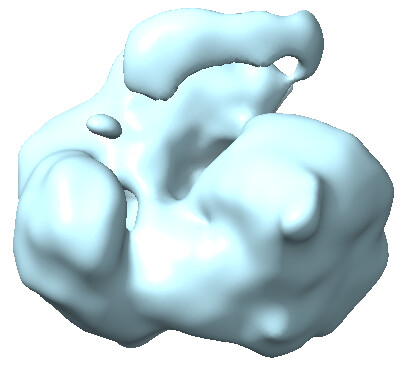
Using Relion, I was able to pick a decent set of particles that appears to have my protein complex of interest. There are 3 components: a dimer binds a monomer. You can see 3 clear lobes in the Relion 3D classification.
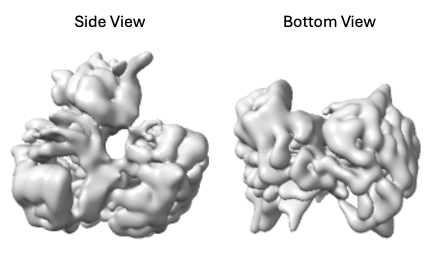
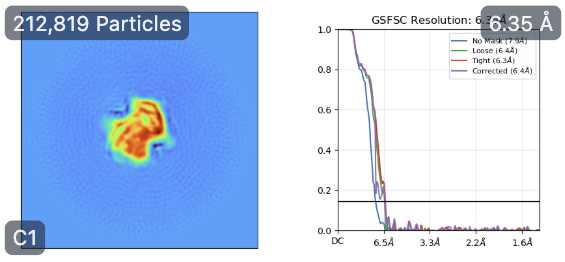
Then, I performed 3D auto-refine in Relion, which gets me around ~6 Å GFSC gold-standard resolution with no obvious severe preferential orientation issues.
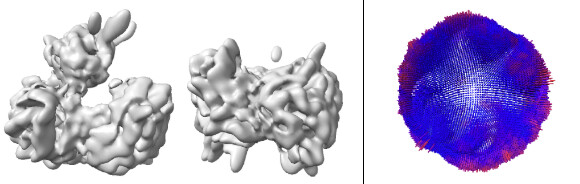
After 3D auto-refine, the CryoSPARC work begins. I extracted these particles from Relion (3x particle diameter box size) and imported them into CryoSPARC. Here are the steps taken so far in CryoSPARC:

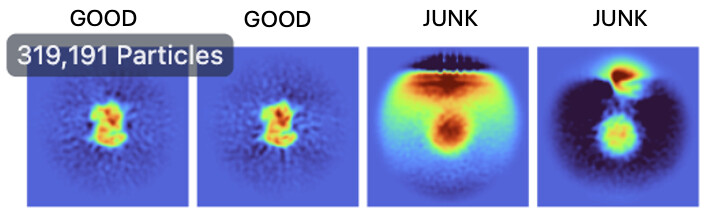
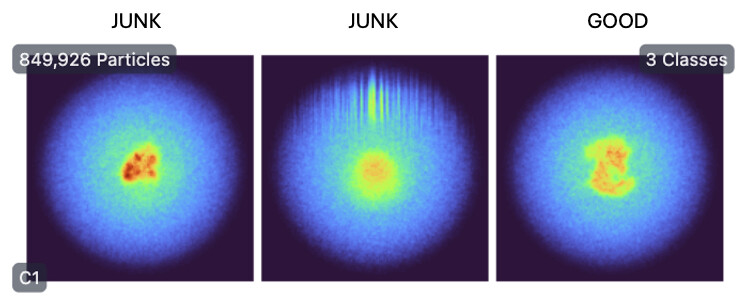
  1. HR-HAIR run with 3 classes. Unfortunately, the job did not fully finish, due to issues detailed HERE (would appreciate any help for this issue too). The job was able to pull out a decent amount of junk though, which is promising.

  2. Subsequently, homogenous refinement and non-uniform refinement jobs on Class 2 volume and particles (the “GOOD” class). This is where things seem to be off. The reported GFSC resolutions don’t match to the features I should see. The density also seems very “blurry.”

  3. I figured the refinement jobs might not have worked well because there was too much junk still. So, I took those particles into heterogenous refinement to pull out more junk.

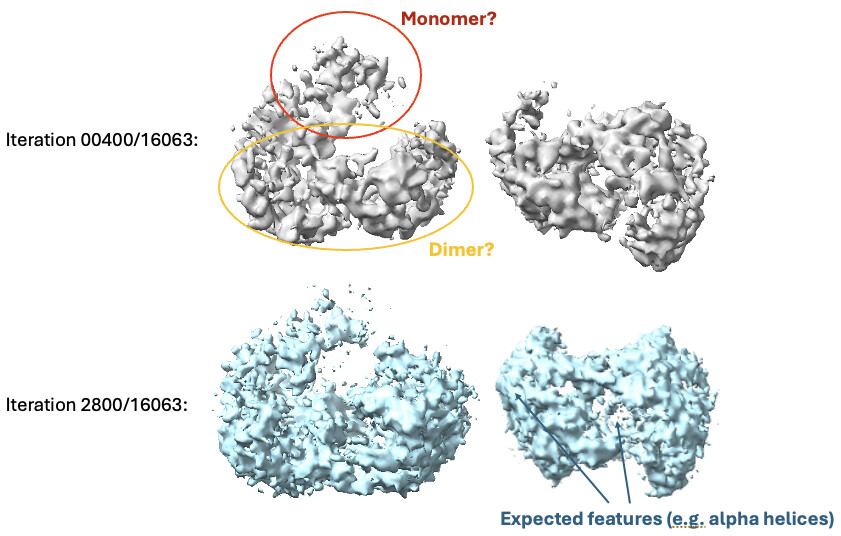
  4. Then, I went back to HR-HAIR with ~213k “GOOD” particles, again with issues running the full job, but I am starting to see features of the already published dimer (without monomer bound). This was really exciting because I’m seeing alpha helices exactly where I expect them. Something interesting was that I noticed that, in later iterations of HR-HAIR, the monomer “disappears,” but the expected features become more prominent. I am thinking that HR-HAIR does a good job at classifying the “rigid” part of the complex, but the monomer might be more flexible/dissociate, leading to weaker density. I also observed this in another diagnostic 2D classification run.

  5. However, this is where things start to get weird again… With this theoretically better set of particles, I took the best volume of HR-HAIR and ran non-uniform refinement. I am doing this because I’d like to eventually go to local refinement, where I can hopefully try to pull out the monomer with weaker density. Unfortunately, I am observing strange non-uniform refinement behavior like in Step #2: blobby density that does not correlate to the reported GFSC resolution.
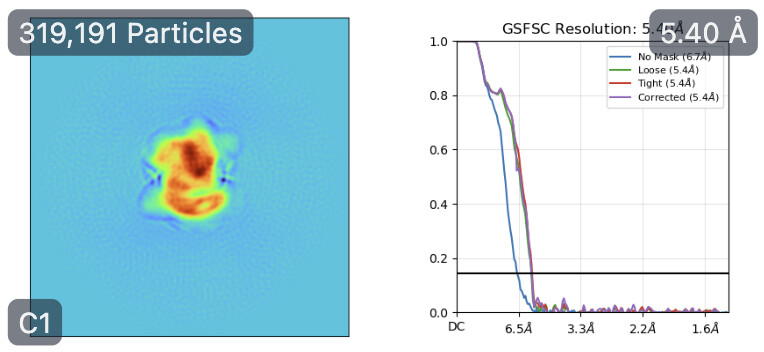
Any thoughts on what’s going wrong here once I take things into refinement jobs? HR-HAIR is clearly getting me somewhere, and it would be great if I can really start locally refining that monomer density. My hunch is that the monomer is bound/unbound and might have a lot of flexibility, which could throw these algorithms off. Does anyone have a suggested workflow that can help me push this dataset further? It might be impossible to get a low-resolution map with both components, but maybe I can get each individual component (dimer and monomer) locally refined well enough that I can create a composite map to make an atomic model.

Thank you all for your advice.
1 Like

Did you try doing homogeneous reconstruction followed by local refinement starting from the “good” ab initio class?

And did you see clear secondary structural features in the good ab initio class?

Oh I just saw the maps you posted - I don’t see convincing secondary structure there - or in the 2D classes. What parameters are you using for 2D classification?

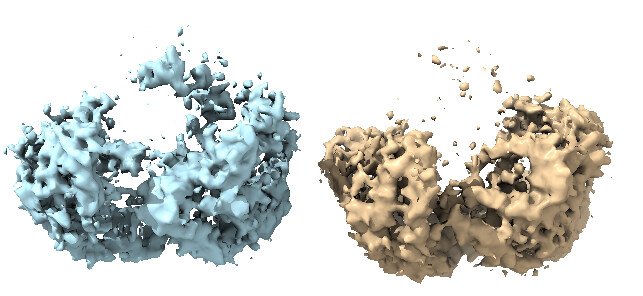
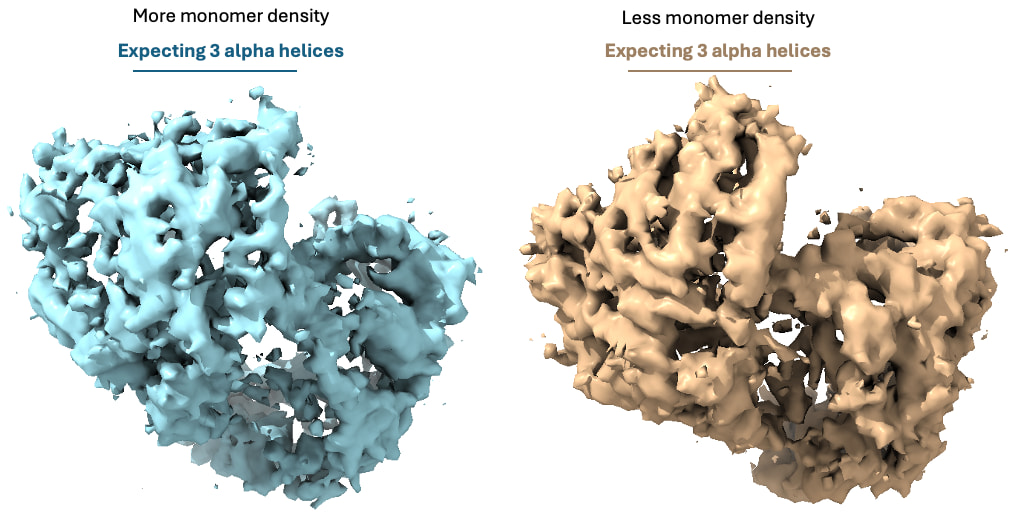
I’ve not tried homogenous reconstruction yet, but that’s a great idea. I’ll do that and update you. For the “good” ab initio class, I think there are clear secondary structures there. In the published crystal structure, I should expect to see 3 parallel alpha helices in this region. In this view, you can see it (and this is only at iteration ~2800/16063, so it could likely improve further with more iterations). I ran with 3 HR-HAIR classes. For the map with more monomer density, the alpha helices aren’t as nice, but in the other good map with less monomer density, the alpha helices become obvious (with my relatively untrained eye, I think). Please see below what I mean.

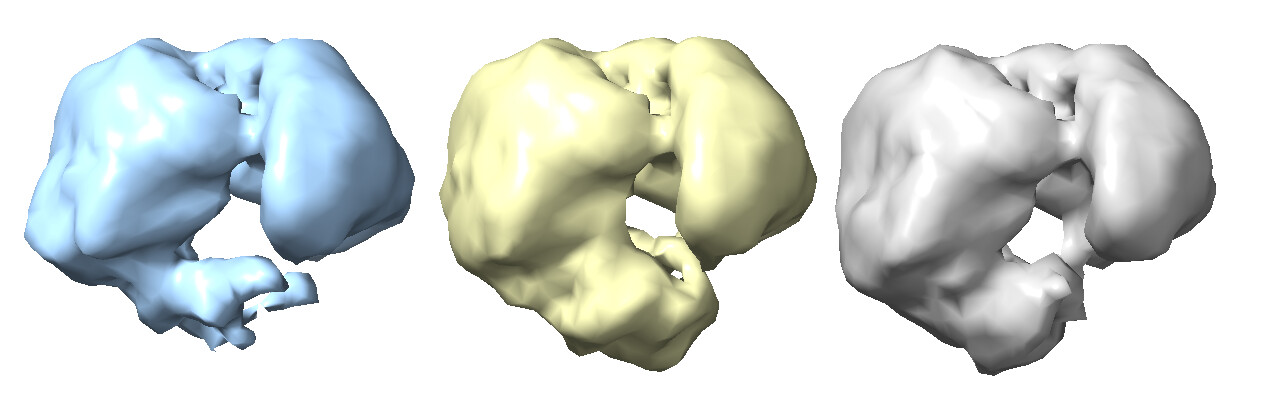
Side view to see the monomer density (same contour level):

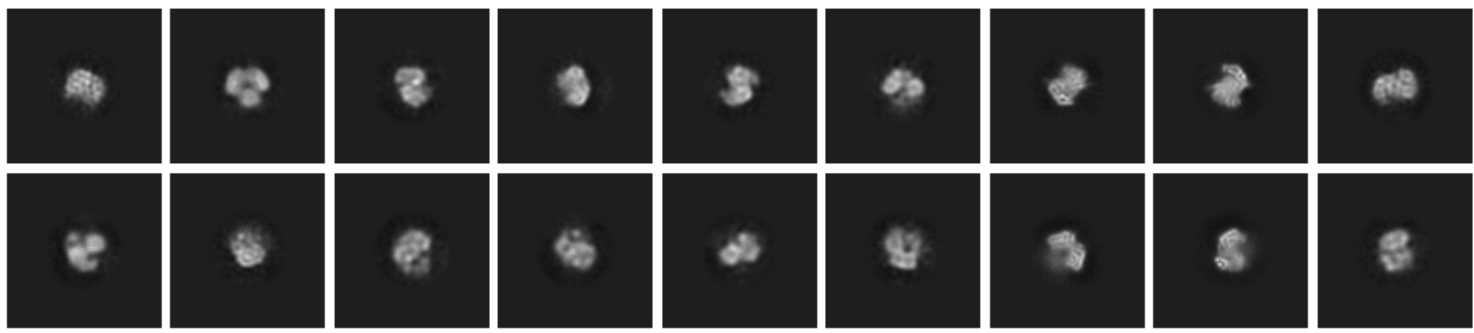
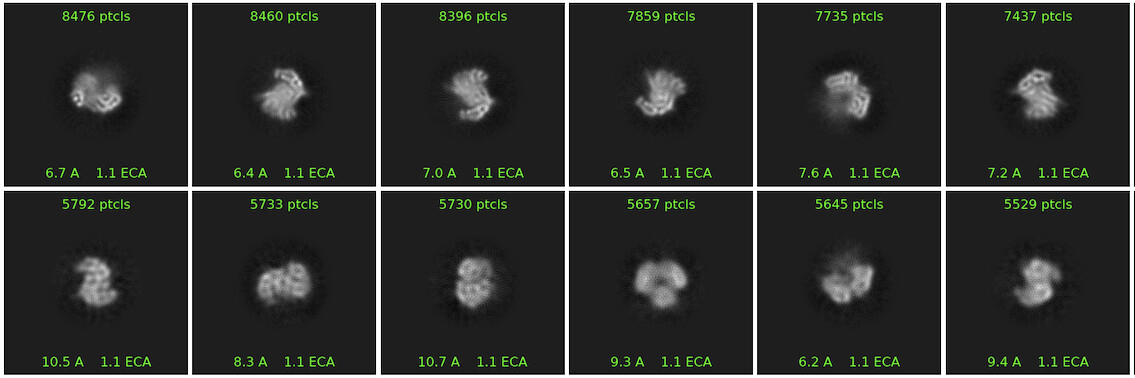
Regarding the 2D classifications, sorry, I posted a pretty low-res screenshot. This might show things more clearly. There’s definitely some “blurring” in some classes. All of the parameters are based on your pre-print(e.g. 200 classes, maximum reconstruction resolution at 3 Å).

Ok, I see - based on these 2Ds I would prob set the start/final res for ab initio to 5 or 6Å (you can see helices in your 2D classes, but cannot see periodicity of those helices)

1 Like

Awesome, thank you for the suggestion. I’ll try this job out and will keep the post updated :folded_hands: I noticed that “homogenous reconstruction” requires a Static Mask as input though. Since Ab Initio doesn’t give one as an output, what should I use for this?
No, homogeneous reconstruction doesn’t require a mask

1 Like

Hi @olibclarke, thank you again for the suggestions. I appreciate that you have a lot on your plate, helping others on the forum too, so all your advice really is appreciated.

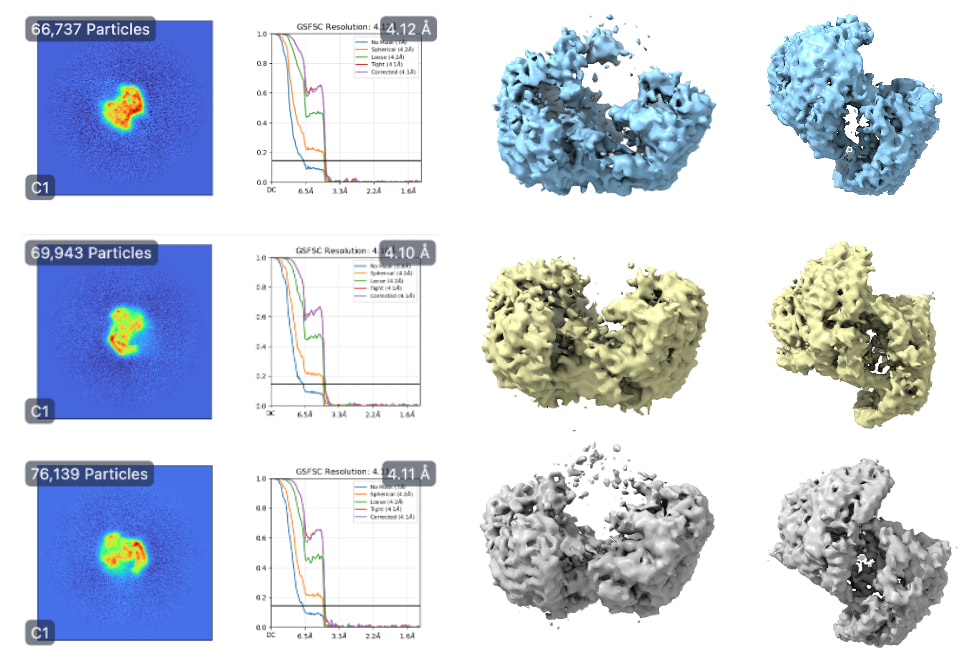
I tried homogenous reconstruction on all 3 classes separately, and it looks like the dimer shows up well. I noticed a 6.5 Å “resolution bump” as described elsewhere. I wonder if this is because I added detergent to my sample or if the protein complex is flexible like that. (I added detergent to reduce orientation bias, and there was too much protein tightly packed on the grid in initial screening endeavors.) In any case, it looks like I can see some overall architecture of the protein complex, especially the dimer.

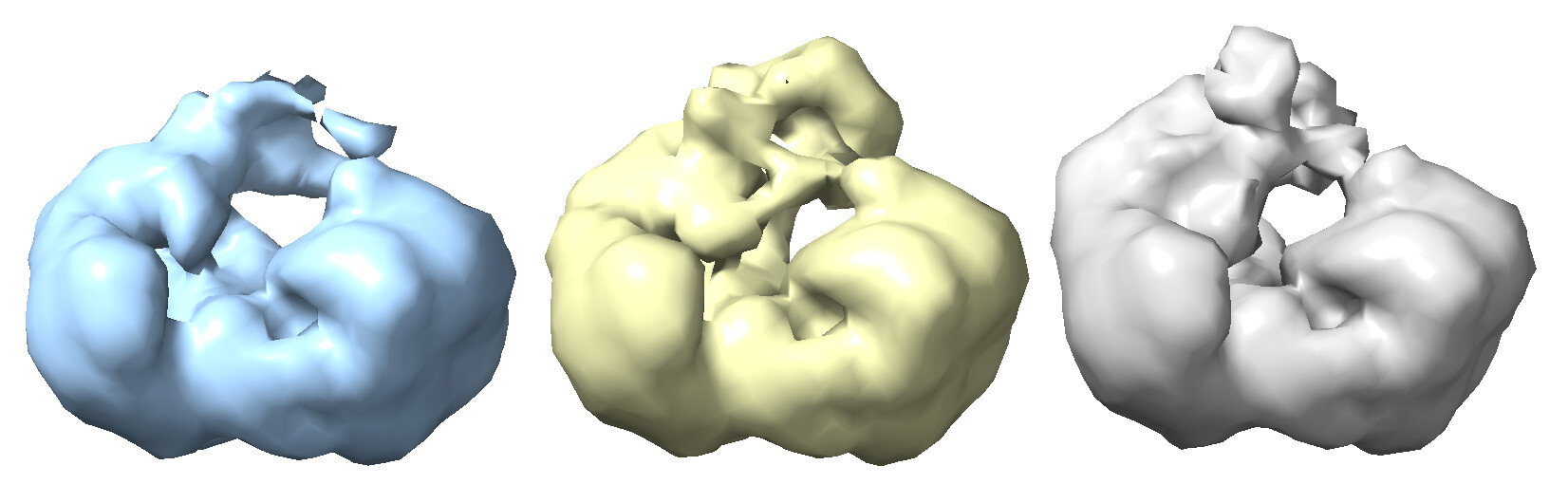
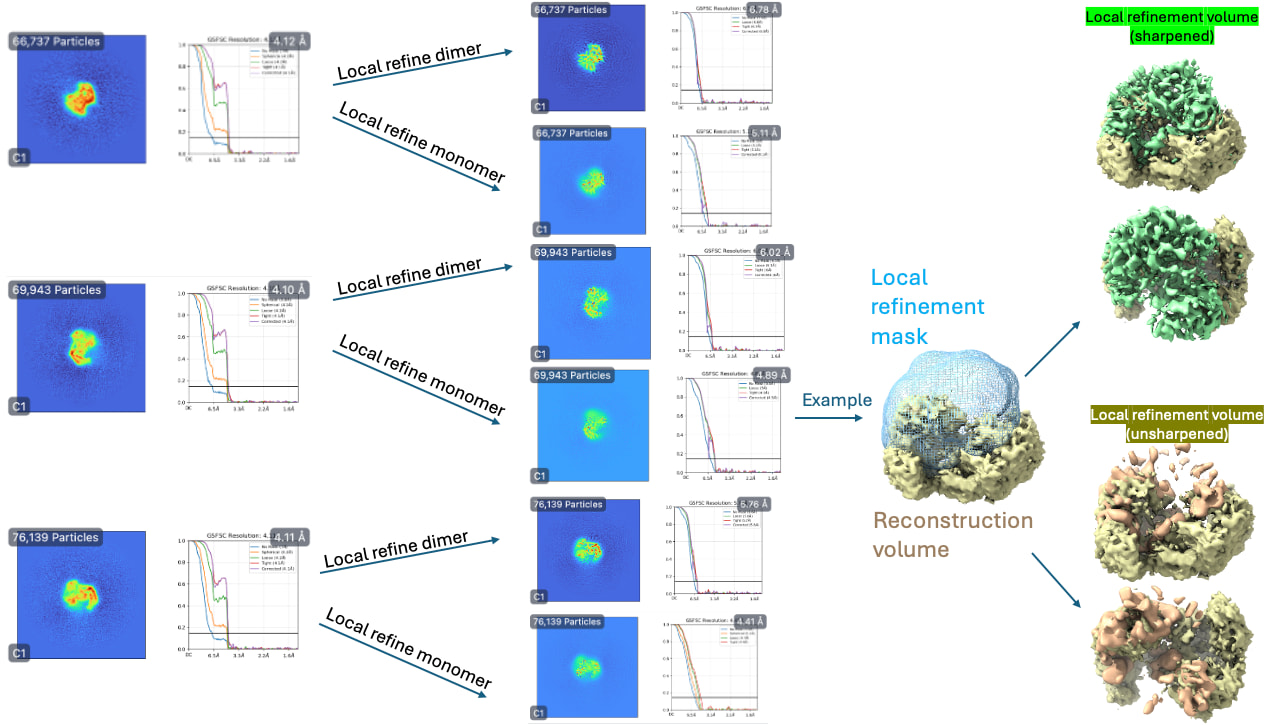
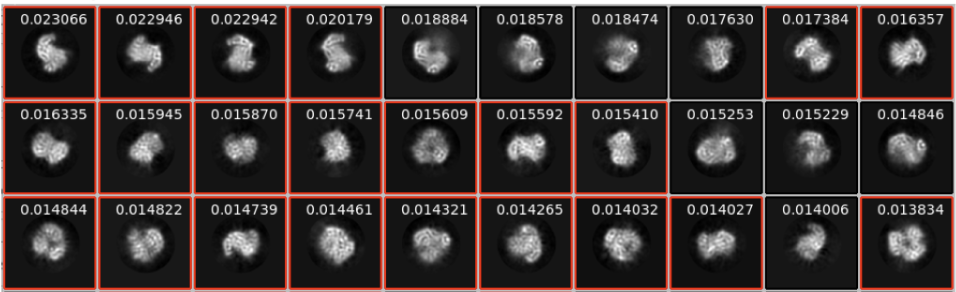
Local refinement is less than ideal currently. You can see that even when I locally refine to the “tight dimer,” I am getting pretty bad deterioration of the GFSC curves. I’m showing one masking strategy and the subsequent volume outputs to demonstrate what the actual maps look like after refinement. Happy to show the other ones too, though I’m not sure if it’ll be too helpful. My concern is that the monomer isn’t there, but it’s strange that the density is much more prominent in Relion. Hopefully, I’m missing something in the local refinement runs and this isn’t some inherent limitation of the dataset. I’ve also tried 3D classification (without alignment) jobs and “Ab Initio” jobs in Relion, and the density does seem to be there and not artifactual, though my interpretation may be due to less mature understanding of how alignment algorithms work in both of these programs. To demonstrate what I mean, I’m attaching an image of a Relion 2D classification “diagnostic” run. (These particles underwent several rounds of 2D/3D classification.) I will give HR-HAIR with start/final resolution at 5-6 Å next. Could this possibly be limiting the monomer density? (i.e. HR-HAIR fits well to the dimer, but the monomer takes a hit because the alignment is on these finer/higher-res features?)

Multiple rounds of 2D/3D classification (Relion, please ignore red outlines/picks, since these weren’t the particles I imported into CryoSPARC):

I also ran a 3D classification job on one of the homogenous reconstructions (66,737 particles) with a focus map in the monomer density region (filter resolution = 10 Å), pulling out some possible monomer density…

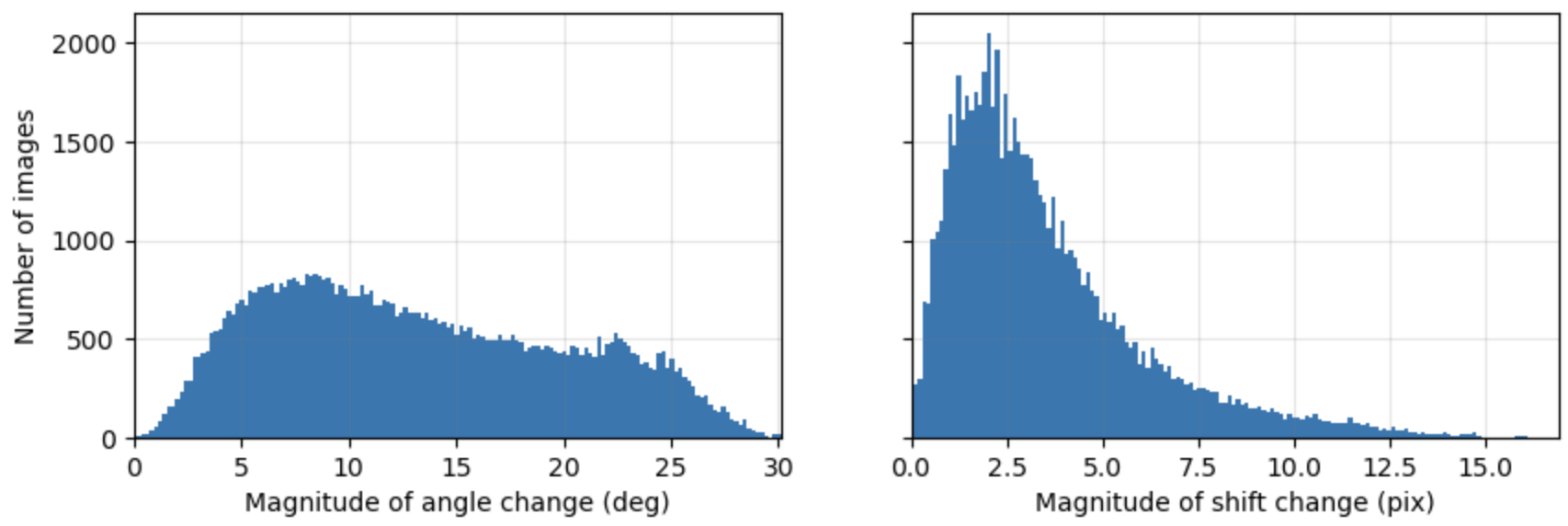
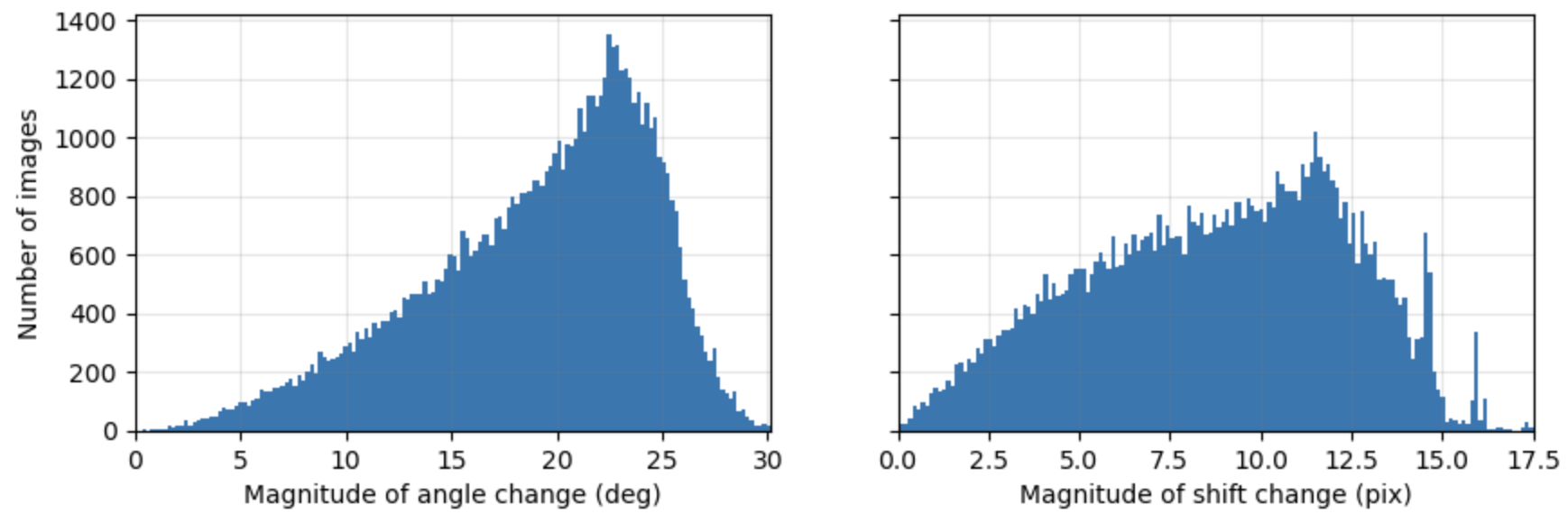
Finally, if it might help diagnose, here are the local refinement alignment changes (1 is the tight dimer, 2 is the ? monomer). It seems like the “monomer local refinement” is not working too well with massive drift, despite the GFSC measure. Perhaps this is starting to get outside of the scope of the initial question, so I might make a new post…

Thanks again so much for the wisdom and help!

For local refinement, I would keep the search range a lot smaller - something like 3deg/1Å, with recentering on. The large search range is probably what is leading to the overfitting you are seeing.

Looking at your 2Ds, I can’t see strong evidence for higher res info beyond 6Å, which is consistent with map features during/after ab initio - hence why I would probably limit initial orientational searches to that resolution.

Re the monomer, I would look for that by 3D classification without alignments, after you have a decent consensus refinement.

If your dimer has C2 symmetry (hard to tell from these images) I would consider imposing that during either ab initio or local refinement, and then running the classification using sym expanded particles.

Cheers

Oli

1 Like

Thanks @olibclarke, the symmetry expansion is a good idea. The dimer is indeed C2 symmetric (reportedly). I’ll give that a shot. Do you think particle subtraction jobs could help?

I wouldn’t bother with subtraction at this point (it will only help once your particles are already well aligned on whatever it is you want to subtract)

1 Like