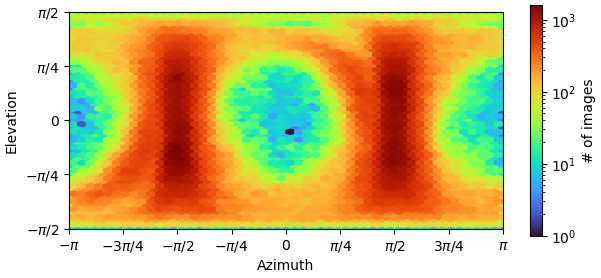
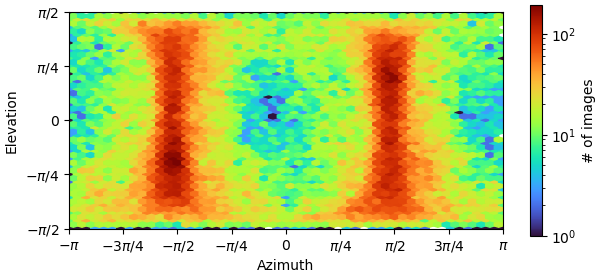
We have some preferential orientation, but what I’m referring at is the fact that in the top dataset it feels like there are two population of particles with two distinct viewing direction patters.
I thought I would able to sort this out in heterogenous refinement, 3D classification, or further ab initio, but it really seems like the stack is quite clean already.
the other explaination i came up with is that the two “populations” are just the same exact complex, but in thinner and thicker ice, is that a possibility?
What am I missing? Has anybody encountered anything like this? and finally, what further strategies could I use to sort these?
I don’t know… both plots reflect somewhat an elongated particle. To me the only difference seems to be that the second plot (previous complex) has much less images, it doesn’t surprise me that they can be aligned with increased precision if they’ve been well selected. The anisotropic FSC and the precision plots can be more informative, I guess. And of course, the quality (visual resolution and anisotropy) of the map are more important. One quick thing to do if you’d like, is to run a rebalancing job based on 3D alignement (exclude the particles in crowded areas that do now align well). But the best is to really have an idea about the heterogeneity of the structures with 3DVA and 3DFlex IMO.
The azimuth-elevation plot is relative to the arbitrary Z-axis (0,0). If the reference was generated ab initio in cryoSPARC, the longest dimensions of your volume is oriented along the Z-axis.
Looks almost as if the Z-axis lies along the plane of your hydrophobic belt, and the half π-radian (±90°) bands correspond to a healthy distribution of “side”-views, with equal probability of aligning with a ±rotation. If so, this flavour of orientation distribution is actually conducive for reconstructing membrane proteins.