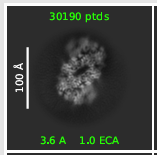
I’m currently working in a small protein(50 kd). In the 2D classification, the largest class consists of rectangular particles, which seem to be completely unrelated to my target protein. Has anyone encountered this type of protein before?
I can tell you that some years ago I was trying to crystallized one protein, but I obtained crystals of a Ecoli contaminant which copurified with my protein and had the same size in GF… what a pity ! I don’t remember its name but it was looking very much like your protein, tetramer ! I will look in my files and tell you if I find the name of the contaminant
You can use ModelAngelo even if this unexpected protein is not from E. coli.
But yes, a good starting point to try guessing what it could be is to tell us which expression system you used to produce your target protein (or if you purified it from its native source).
One option would be to switch the affinity tag if possible. Since your protein is about the same size, it likely co-elutes on SEC.
I seem to recall also that there are immobilized biotin columns like this one: Immobilized Iminobiotin Resin that labs have used to purify Streptavidin. I am not sure if that would bind StrepTactin but if it could, you could incubate with a small amount of that resin after SEC to remove the StrepTactin.
Strep-tactin resin often purifies biotin-containing proteins along with the strep-tagged protein. We see the BCCPs (biotin carboxyl carrying protein) such as MCC/PCC/PC in samples, these proteins have a covalently (lysine) attached biotin that moves between two locations (carboxylase and transferase) so can be easily accessible and bind the resin. Different symmetry depending on the protein (C2/C3/D2/D3), using just a few thousand particles is often enough for low 3A and modelangelo identification.