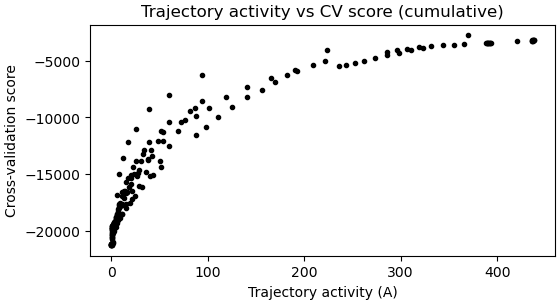
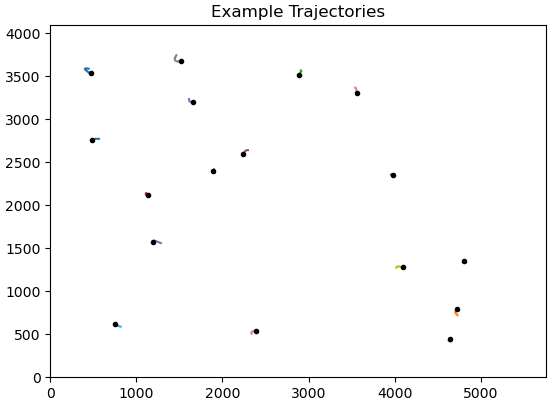
I have encountered the same issue several times while using the Reference-Based Motion Correction job. During hyperparameter optimization, the job exits early with the following message: “Exiting early, all search paths have reached the ~zero trajectory regime.”
I am wondering why this occurs. I checked the trajectory vs. CV plot, and it appears that the minimum is indeed located at 0 Å. Please have a look at the attached images.
After performing reference-based motion correction, I subjected the particles to both non-uniform refinement and local refinement, but neither resulted in any improvement.
For context, the dataset has the following characteristics:
Movies are in TIFF format, with 50 frames and a total dose of 50 e⁻, collected on a K3 detector.
The particles have been thoroughly cleaned, with approximately 100,000 particles remaining.
Could you please advise on what might be causing the optimization to converge to the ~zero trajectory regime and whether this indicates that reference-based motion correction is not beneficial for this dataset?
Thank you very much for your time and help with this issue!
My case is different to the one you post as the minimization happens only at 0 A trajectory activity… and I cannot manually select other hyperparameters by hand.
Maybe @hsnyder or other cryoSPARC admin can help here!
Thanks for your question about Reference-Based Motion Correction.
The message you are seeing is because the optimisation step finds that a zero-trajectory is the best solution for your data. This is likely linked to the resolution of the input map.
We generally would not expect to see an improvement in map resolution or quality after Reference-Based Motion Correction when starting from ~6-7 Å, but it could be worth revisiting if further processing of this dataset later achieves higher resolution.
I am currently limiting the box size based on the resolution indicated by the GS-FSC of the full complex, mainly to increase computational speed. However, if I were to use a larger box size in Fourier space, some regions of my complex would contain information reaching ~3 Å resolution, while other regions would not.
If I understand your reply correctly, increasing the box size could potentially result in more accurate trajectory tracking. Is that correct?
If so, I think this would be useful information to include in the cryoSPARC documentation for this job. For example, RELION’s approach seems to be able to track the particles correctly in this situation and subsequently improve the GS-FSC without changing to a larger box size in Fourier space.
If I understood correctly, your particle box has been Fourier cropped and is limiting your input volume to ~6.8 Å. The fraction of Fourier components to use for alignment is 0.5, so this means that for your case Reference Motion Correction will only have low-resolution features to try and optimise hyper parameters.
For early processing steps, such as crude particle curation, Fourier cropping can certainly help speed up the job runtime, however it is usually worth re-extracting particles with a smaller pixel size and re-refining before running Reference Motion Correction, so that the input volume used for hyper parameter optimisation is higher quality, and not significantly limited by the Nyquist frequency.