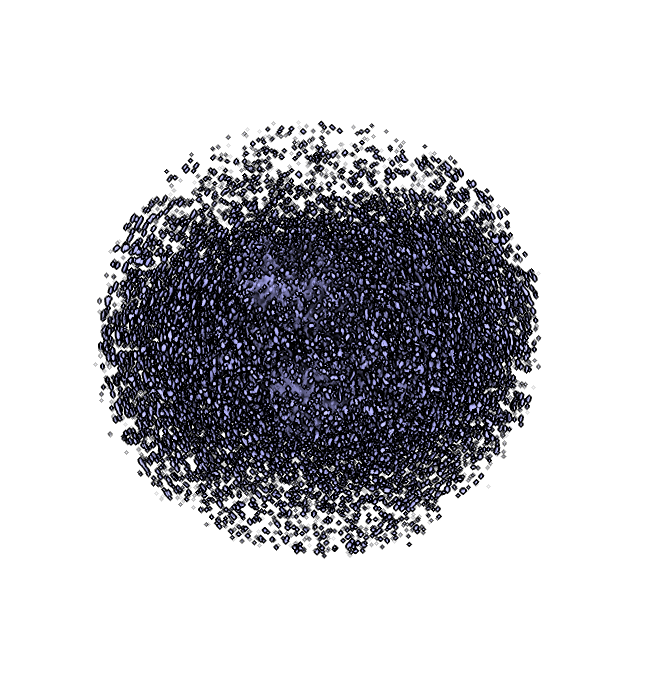
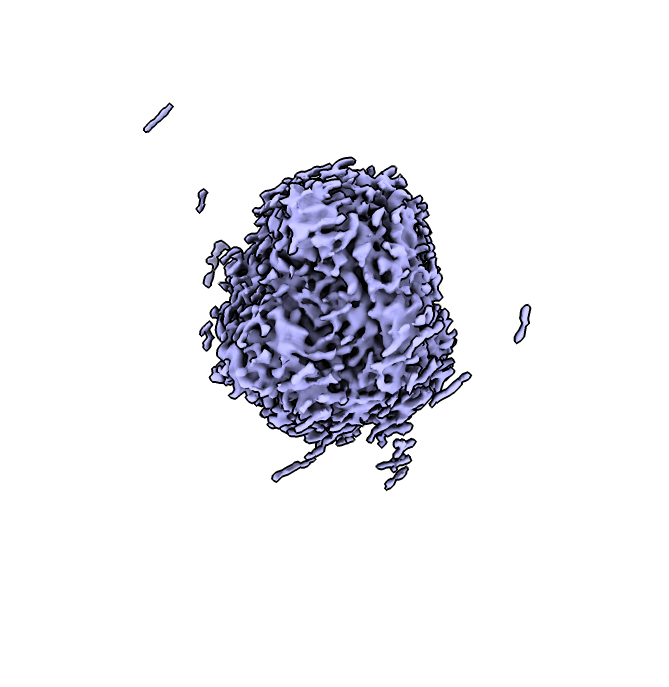
I’m writing to ask for advice regarding an issue we’ve encountered during cryo-EM map processing. After performing NU-refinement (non-uniform refinement), the resulting map appears to contain a significant amount of “dust”—that is, small, scattered density features that are not clearly associated with the main structure. As a result, the overall architecture of the map is not easily interpretable until we apply a “clear dust” step.
Why does this dust appear predominantly after NU-refinement, and is there a way to filter or suppress such noise during the refinement process itself?
Are there specific parameters or strategies in NU-refinement that could help reduce these artifacts?
Hi @Yan30 , I don’t think this is just a question of tweaking parameters for the refinement. This is really looking like the program is not able to properly align the particles. Your dataset might be still too dirty, or, there is a very common cause for this, it’s protein flexibility. You can refer to (many) other posts in this forum by looking for “flexible protein” or related keywords. There are case studies recently put in Youtube: https://www.youtube.com/watch?v=TFcTP33TKUo&list=PL39mLm0042zJk_ZkM2_OaIoL78uYj6JAb&index=6 . This is much harder than the usual apoferritin data processing pipeline, but it is also much nicer as you will hopefully learn a lot about your target protein.
Of course if someone else wants to add other potential causes for this kind of noise with rotating/melting maps, I’m all ears.
Hi,oh, after multiple tests, I realized that the extraction box I chose was too large. When I re-extracted using a smaller box and performed NU-refinement, the noise was significantly reduced.
In fact, this did not significantly improve the resolution, but the first measure noticeably reduced dust, and the second made the GSFSC curve smoother.