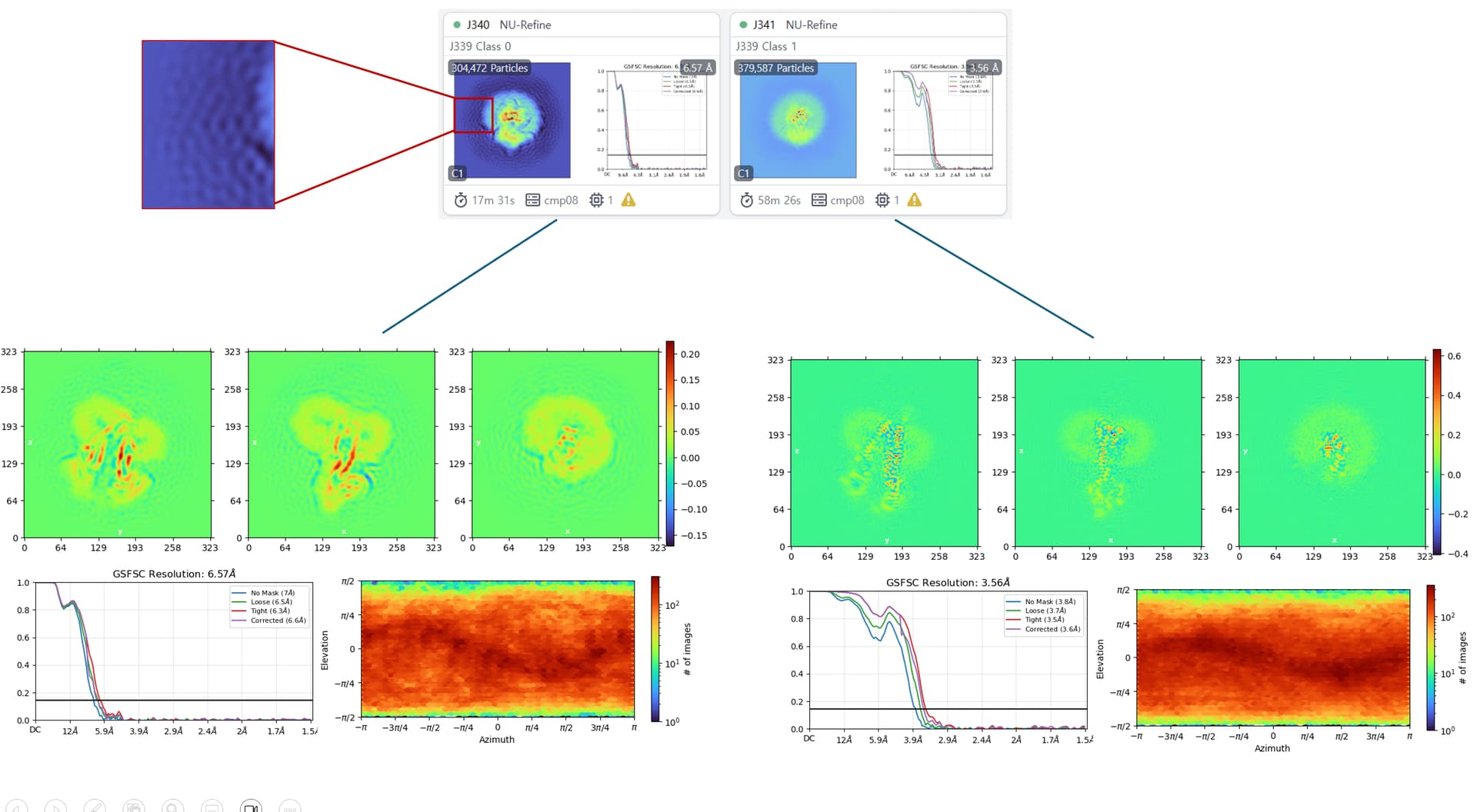
My sample is a membrane protein. After hetero-refinement, I obtained two non-uniform refinement classes (J340 and J341), which seem to differ due to structural heterogeneity—particularly the presence of a flexible two-helix region.
I’m trying to understand why the J340 non-uniform refinement produced a relatively low resolution. The real-space slices also appear distorted or “wavy” in the region highlighted in the red box, and the gold-standard FSC curve converges at a lower resolution.
Could you explain what factors might cause these issues, and suggest how I could approach or troubleshoot this type of problem?
J340 is overfitted. The artefact line around the volume slices where the mask cuts off makes that clear. The wavy lines are often a warning that overfitting is occurring too.
I’d recommend running further 2D classifications with the particles from each job, see what the classes look like. Chances are, the classes from J341 will mostly be high resolution with distinct, clear features, while the classes from J340 will be lower resolution and lack any sort of clear details.
In our hands hetero refinement works best when you give it one or multiple “trash bins” to throw junk particles (dummy maps or multiple times the same maps). Did you feed only two maps? Maybe J340 comes from a mix of good and bad particles? Also keep in mind that hetero refinement - just as every other classification job AFAIK - will not take only the protein conformation into account, but also signal-to-noise and contamination (even more importantly than protein conformation because these will make more difference in the signal), so if you want to take conclusions from the results, the initial set has to be clean. And because all this is done based on probabilities, it is always of good practice to take the outputs and insist on cleaning (try to recover good particles from the “bad” set, and eliminate bad particles from the “good” set, then merge the refined sets together to really classify conformations). Woks best when you use different methods for each step, not simply repeating hetero refinement.
Ah, Type-IV ABC transporters ! I know them very well and I see this all the time indeed.
While the advices above are all very good, there is most of the time not much you can do. These beasts are very flexible and 3DVA is your friend. Focus on refining your high-res one, and search for movements around it. Sometimes, one NBD can disappear from the reconstruction as the alignment will occur on one “leg” vs the other one.
Playing with symmetry and particle expansion is also in the todo list.