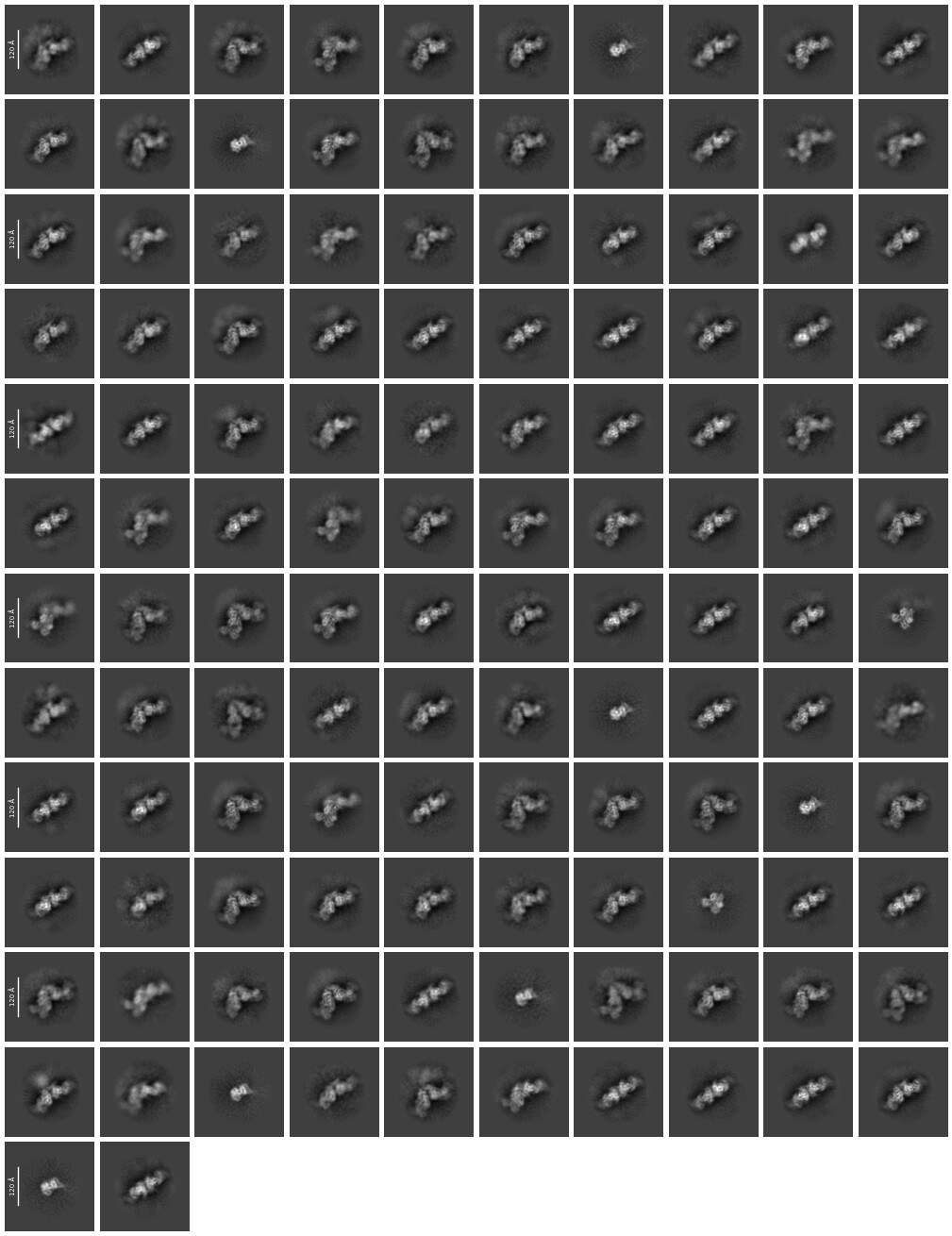
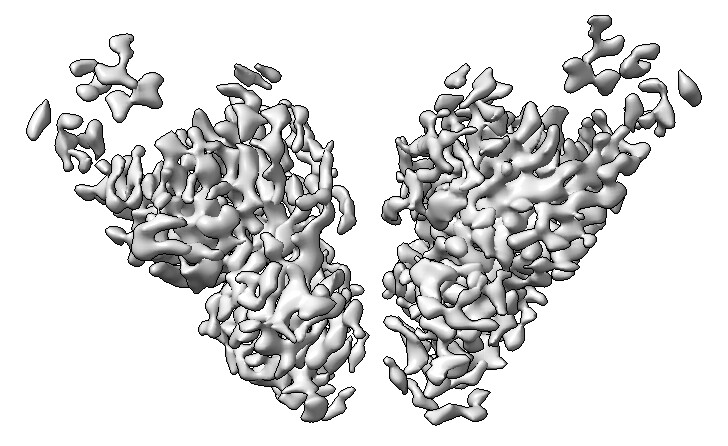
I am currently processing cryo-EM data for an antigen-antibody complex. My 2D classification results appear good, with class averages obtained from most viewing angles. However, I have been unable to generate a proper initial model. Although the final reconstruction map reaches a resolution better than 3.5 Å, it contains no high-resolution features, and protein side chains are hardly visible. Besides, my dataset also suffers from preferred orientation.
Could anyone suggest practical approaches to obtain a reliable initial model?
How many classes did you request for the ab initio reconstruction? One is definitely not sufficient, as it will force different particles in the same class, and from the look of your 2D class averages it seems like there could be some flexibility in this complex.
If you haven’t already tried this, I suggest requesting 4 to 8 classes for ab initio reconstruction, and limiting it to a smaller number of particles than your whole set (say 50 000) so the job completes faster. No need to pass all particles through the ab initio job, you only need some reasonable-looking initial model to prime the process. Then you should run heterogeneous refinement on all particles, with one “good” ab initio model to attract good particles and multiple copies of the nonsensical ab initio models (if you got any; it’s fine to enter the same one multiple times if you only got one bad one) to attract false positives from picking that won’t align well to anything (there is always some small fraction of those, even with careful picking and curation, and it can be easier to sort them by heterogeneous refinement).
I’ve also seen ab inito struggle with C2 symmetric dimers (seems to be the case here?), you’ll sometimes get a “flattening” effect along the symmetry axis. You can try with more classes as mentioned above, but also (cautiously) test with symmetry enabled and 4-8 classes with a small particle subset. Once you get a decent starting model proceed without using symmetry unless you really need it.
If ab initio defaults are struggling, a few things to try can be:
Disable “Center structures in real space”.
3-12 classes.
Increase starting res (maybe 20 Å).
Increase target final resolution (maybe 8Å).
Run 2D again, select 2-5 clearly different classes → feed into single class ab initio (do not recommend if not familiar with sample!)
If large particle stack still, clean obsessively to remove as much junk as possible (there is some always hiding - particularly with the CryoSPARC 2D class defaults)
But strong preferred orientation is going to cause big problems. If a “quick fix” is needed and you still have the grid and 'scope time, collect 1-2,000 images with a 25+ degree tilt. If new sample required, try carbon film, CHAPSO or some other methods to stop/minimise the anisotropy.