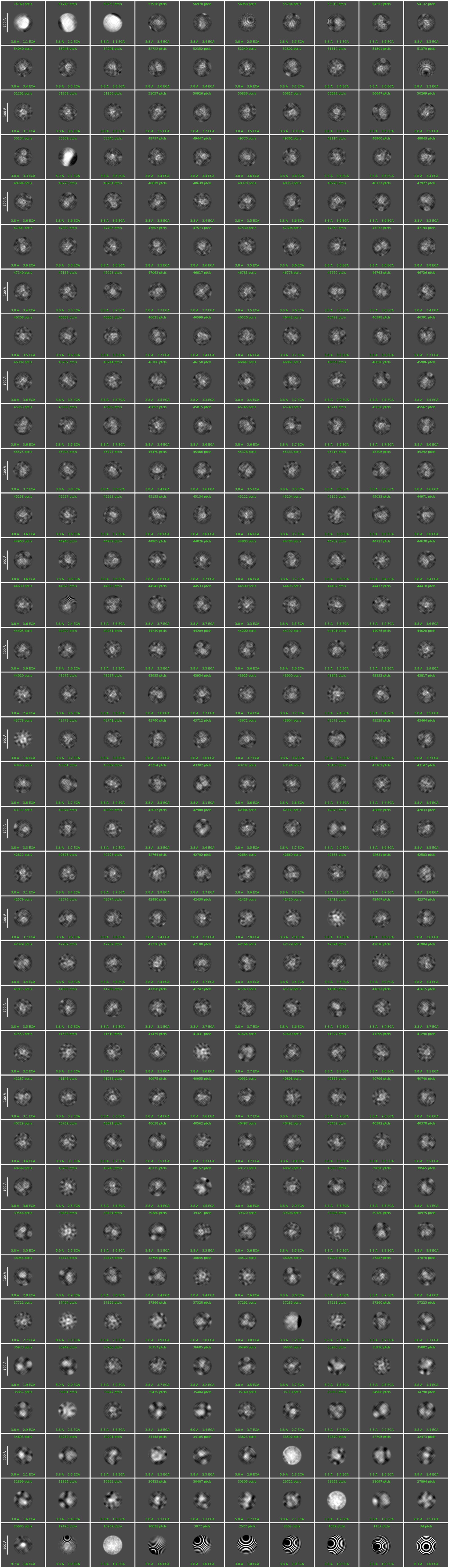
I am trying to process data for 95 kDa dimer (`~48 kDa monomer). I have used 80 A - 140 A blob for picking the particles. Particles were extracted using a box size of 320 Å and a Fourier crop to 100 Å. But we are observing fuzzy classes. Micrographs are crowded, and I guess there is some dissociation of the dimer at the air-water interface.
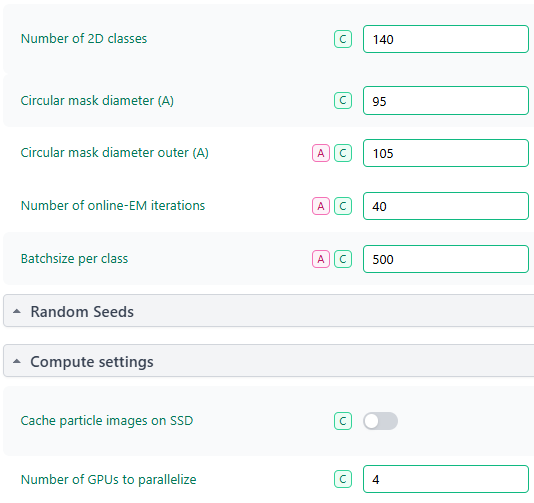
Any suggestions or parameters needed to optimize particle alignment will be helpful. I have used a mask of 100 A and an outer diameter of 110 A. The batch size was 300. Pixel size of micrograph is 0.74 and mag is 165kX
Possibility number 1: Ice too thick.
Possibility number 2: high particle count in classes with high heterogeneity.
Potential solution 1: thinner ice (easier said than done, I know…)
Potential solution 2: Select all classes which are obviously not junk. Run another 2D. Continue until clearer classes start appearing, then use those for ab initio. When some nice ab initio, feed first “clean” stack to heterogeneous refinement and good ab initio models plus some junk models. Iterate from there.
Thank you @rbs_sci , I have removed obvious junk classes and kept all other classes and started the second round of 2D classification. I will check the Ice thickness once in a curate micrograph module because I had fed only the CTF resolution limit (0, 5 A).
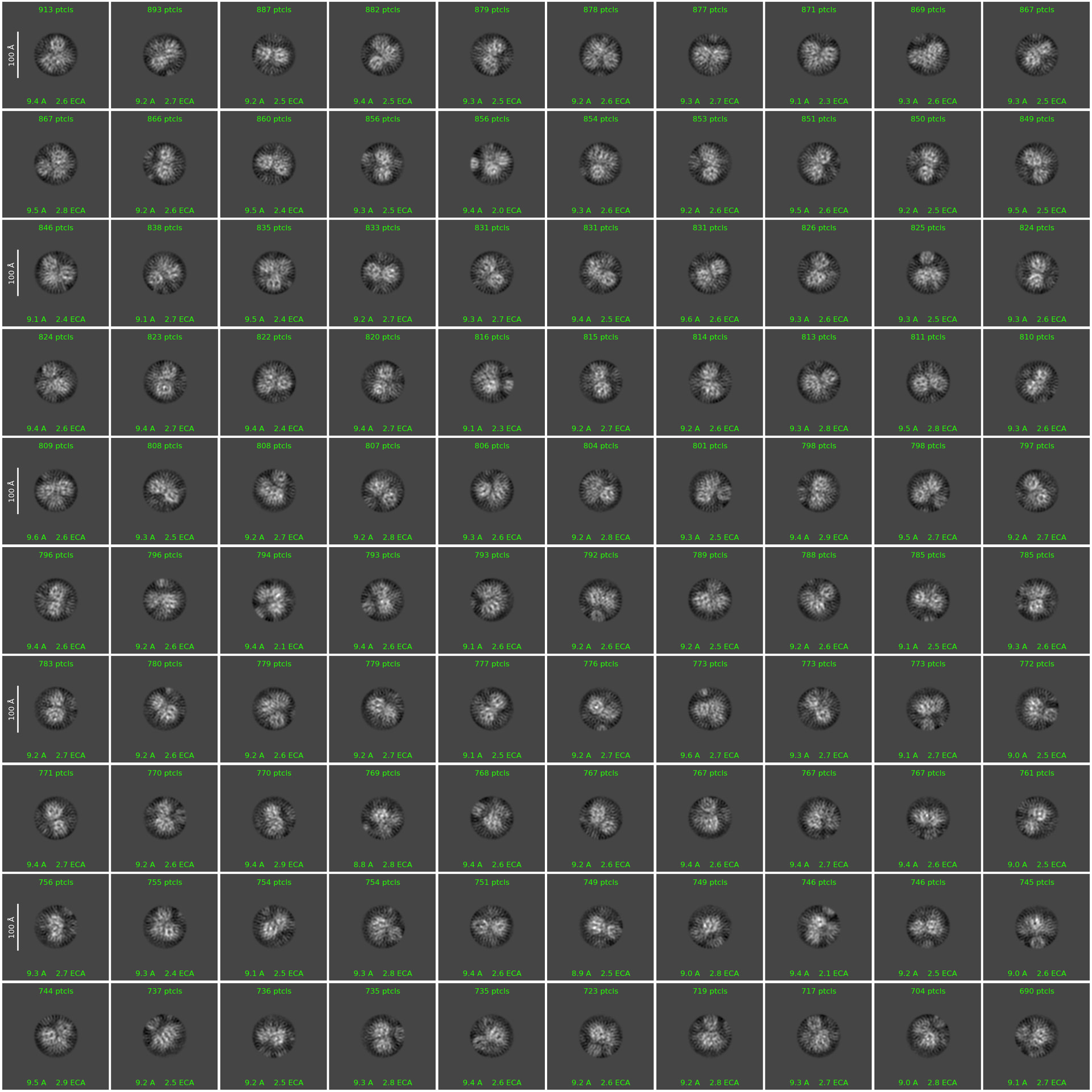
As per your suggestion 1, I have done a subsequent round of 2d classifications, from 15000K particles, it reduced to 1800K particles. Fuzziness is reduced. For the second suggestion, I have implemented an ice thickness threshold, and the 2D classification is underway; I will update once it is complete.