I am relatively new to CryoSPARC and would appreciate some advice on processing my cryo-EM data.
I am working on a 165 kDa homotrimer that MD simulations have shown to be highly flexible, with at least four different conformations.
I collected approximately 40,000 micrographs on a Glacios (0.914 Å/pixel, 50 e⁻/Ų), resulting in around 13 million particles.
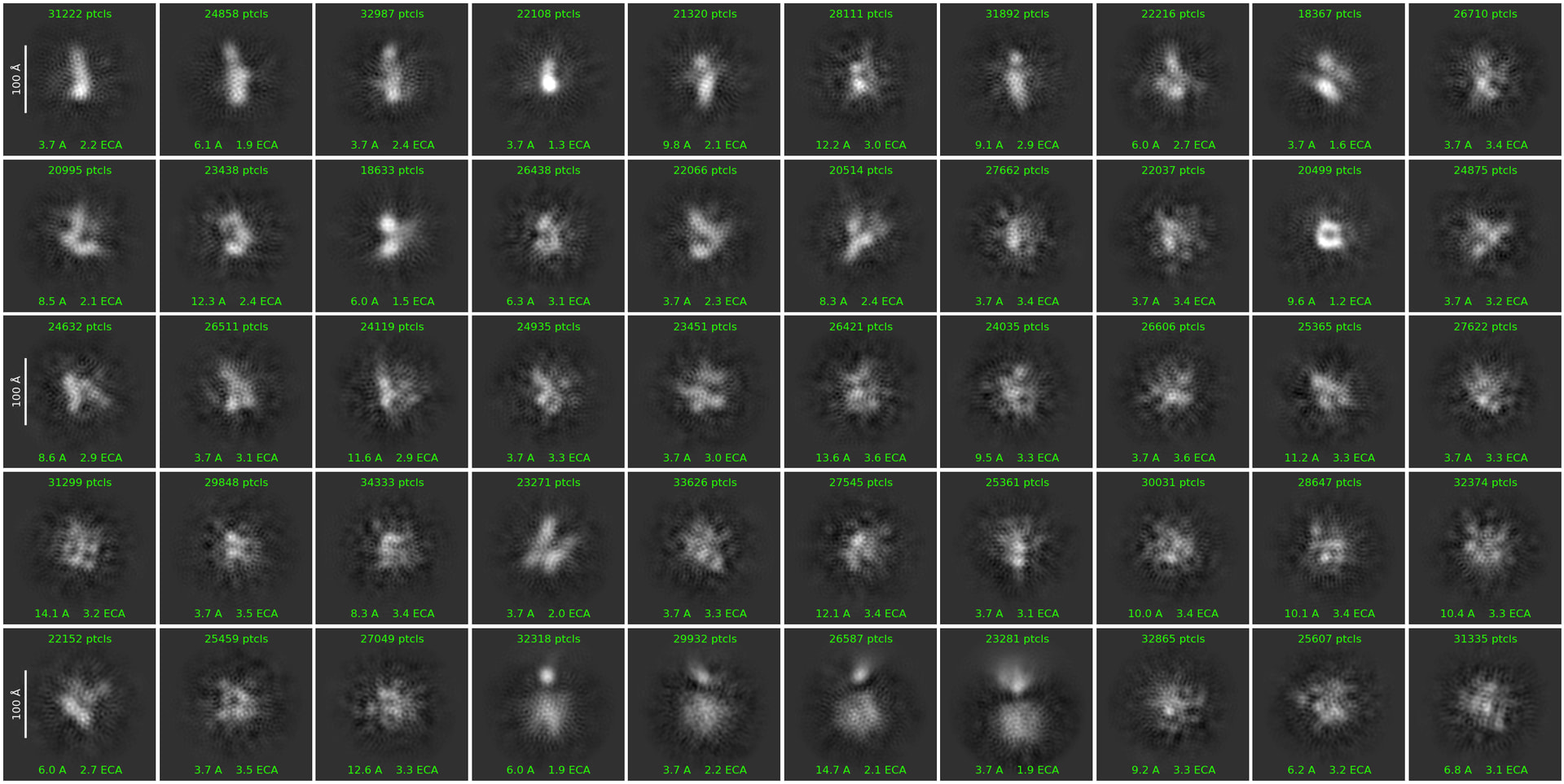
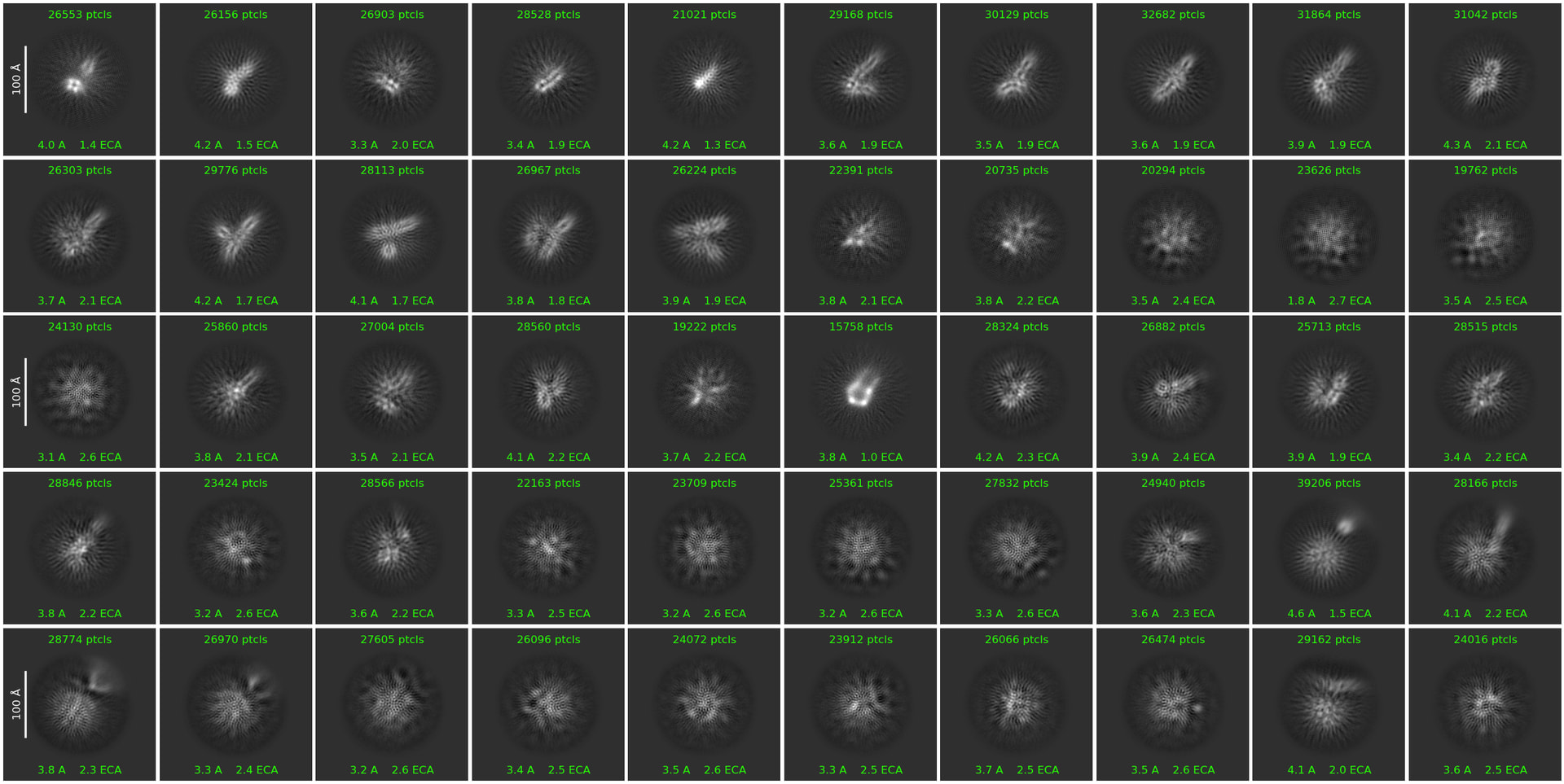
I have performed two different 2D classification approaches (classical 2d and second changing in the parameters), but I am now unsure how to proceed.
My main concern is that selecting only the best-looking 2D classes might cause me to lose particles corresponding to alternative conformations of the complex.
Would you recommend:
Selecting the best 2D classes before running ab initio reconstruction?
Keeping more ambiguous classes and directly exploring 3D heterogeneity?
Using the four conformations predicted by MD as initial references for 3D classification?
How would you approach this situation to avoid discarding potentially interesting particles while still removing junk?
Any suggestions or recommendations would be greatly appreciated!
That is a massive dataset and a lot of particles. I would recommend to do further rounds of 2D classification with more classes: at least 100 classes though 200 classes would be ideal. This is because you have 2D classes with more than 30,000 particles which is quite a lot, so the features of the 2D classes may become too blurred and unclear.
It is best to pick the best particles to get initial 3D volumes. Once you get volumes that you are confident with as being your complex you can always go back and do rounds of 3D heterogenous refinement with these volumes and some junk volumes to retain all your good particles using your initially extracted particles before 2D classification.
I would recommend working towards a consensus 3D volume and using that to sort out your alternative conformations. The options to deal with heterogeneity in CryoSPARC are really powerful, but tend to require clean particle stacks. As pointed out by another user, you have LOTS of particles in each class currently. You could decrease your input particle count as well as increase the number of classes and this might help. Especially with a larger number of classes (say from 50 to 100), what is and is not junk should be clearer. From there try ab initio on the classes (particles from them) that look “good,” and hopefully that produces a nice enough volume to work with (try this job with a variable number of ab initio volumes too, say 1,3,5,etc).
I would suggest not using the four predicted conformations from MD as that can introduce bias and unless the models are very similar to the data its unlikely to be successful. But, if you aren’t constrained on computational resources you should give it a shot, you might as well! Instead, I would recommend generating an initial volume, filtering your particles through it with some junk classes using heterogeneous refinement, then taking that cleaned particle stack through 3D classification.
Especially since you mention it is supposed to be highly flexible, 3D variability might be very useful. This could give you an idea of how the flexibility is behaving as well as even sorting the different conformations. Unfortunately, this also needs a nice particle stack.