Hi everyone,
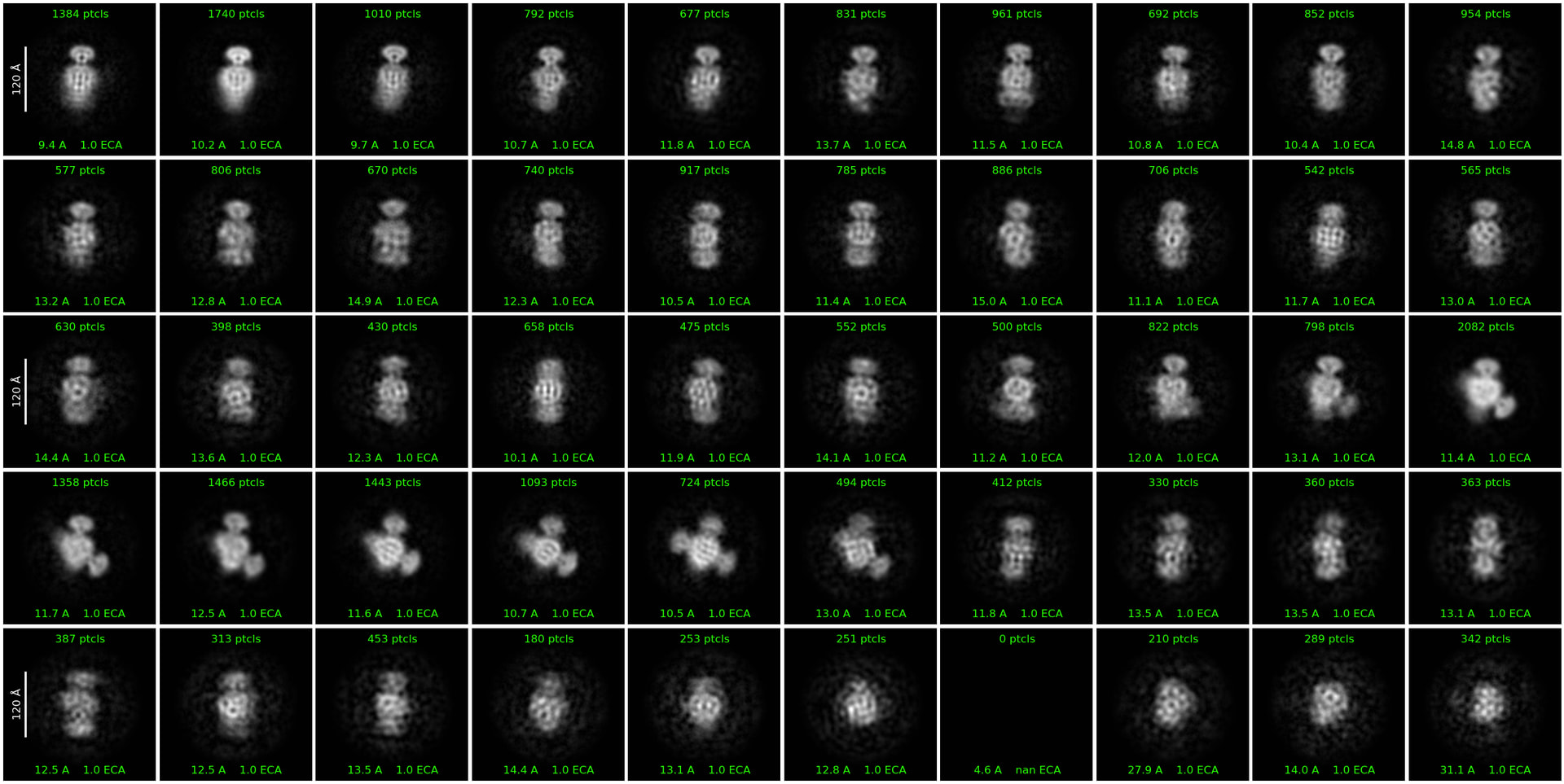
I am having a difficult time obtaining good 2D class averages for an ABC transporter that was solubilized using CubiPol polymers (Cube Biotech GmbH). As I understand it, CubiPols work on a principle similar to SMALPs, where the membrane protein is extracted together with a patch of membrane surrounded by polymer. From the 2D classification, I can see a clear preferential orientation, but I hardly see any recognizable secondary-structure features in the class averages. I discussed this with the Cube Biotech team, and they mentioned that, unlike nanodiscs, polymer-solubilized particles may not have a well-defined or uniform boundary around the membrane patch.
Could this heterogeneity in the polymer/lipid boundary affect particle alignment and consequently the quality of the 2D class averages? In other words, does the lack of a well-defined particle boundary in CubiPols make alignment/classification more challenging? I have also tried tweaking 2D classification parameters in CryoSPARC, including solvent flattening/clamping and non-negativity constraints, but the class averages did not improve substantially.
Interestingly, I have a DDM-solubilized dataset of the same transporter where part of the protein appears to have dissociated, but the remaining protein shows recognizable secondary-structure features in the 2D classes. In contrast, with the CubiPol-solubilized sample, the particles appear to align preferentially, but the secondary-structure features are largely absent.
Has anyone experienced similar issues with CubiPol/SMALP-solubilized membrane proteins in CryoSPARC? I would particularly appreciate advice on whether this is likely to be a particle/alignment issue caused by polymer heterogeneity, or whether I should be looking more closely at the sample quality, particle picking, or other processing parameters.
Thanks in advance!