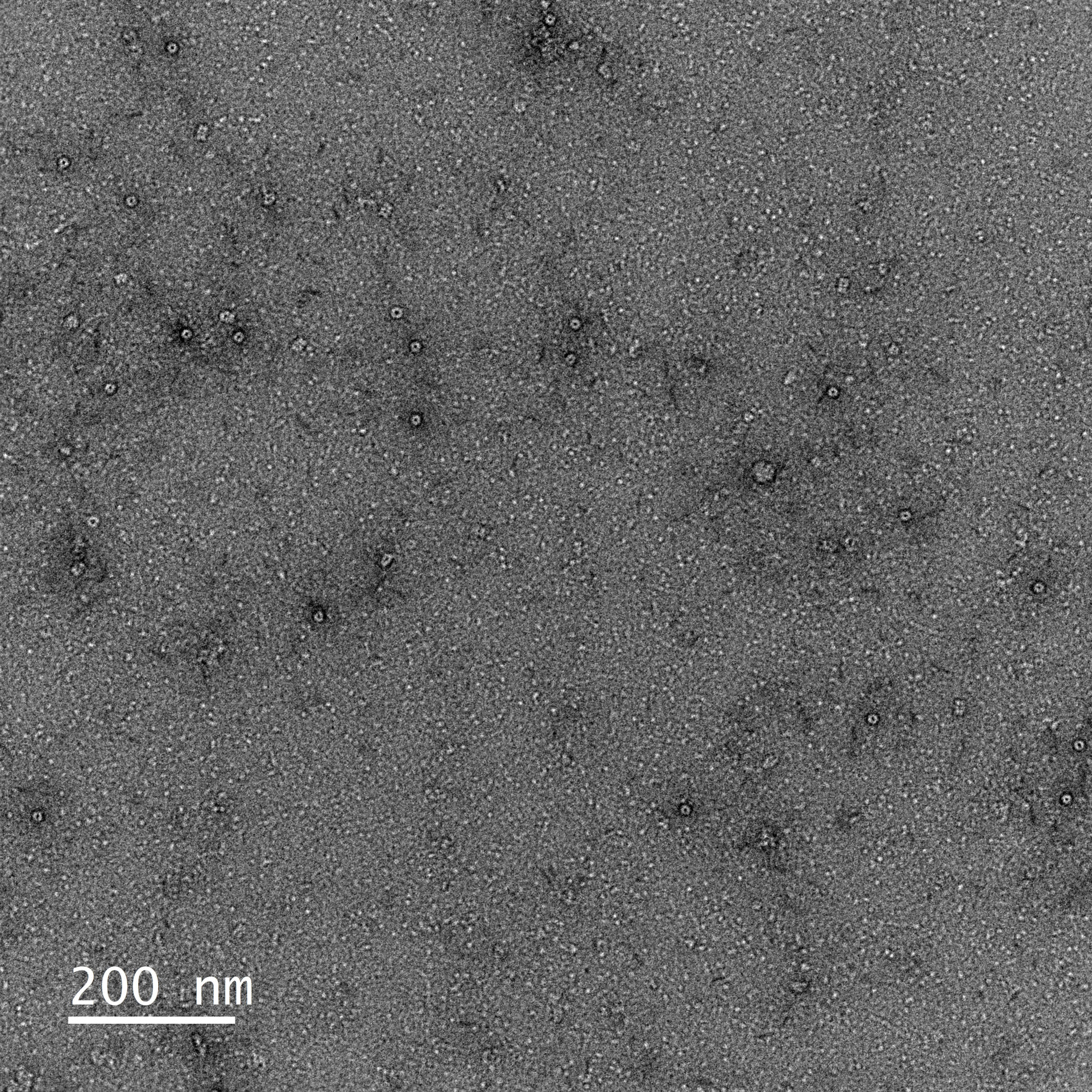
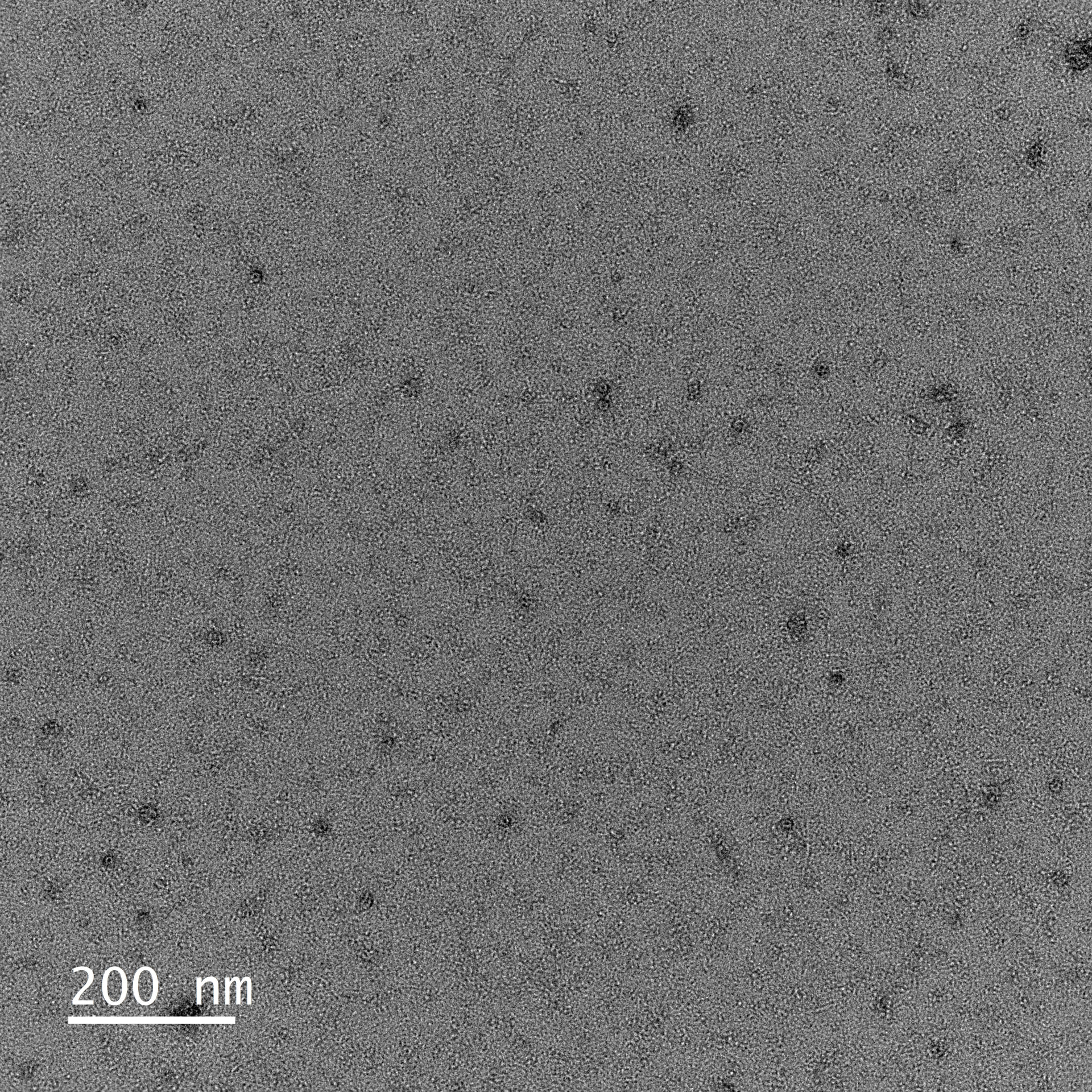
I am a noob in this field and need a little help before I jump into processing. I was trying to do negative-stain EM with my protein (viral polymerase). After changing many conditions, I am now getting something that kind of looks like my molecule, but it appears to be only in one orientation. I have attached the micrograph here (the globular particle with a hole in the center; magnification 40k×; particle diameter ~150 Å). However, because it appears only in one orientation and does not exactly resemble my molecule, I am unable to rule out whether it is some kind of artifact. The feature is reproducible and has a consistent size.
These little donuts sure look like protein. But this seems like very low concentration, you will need something like 10 times more for vitrification. I wouldn’t worry about preferred orientation at this stage: in negative staining preparation, particles are deposited on a film, which definitely causes preferred orientation of certain particle shapes. But this might not happen as much to particles freely suspended in vitreous ice; or if it does, it will be for different reasons and can be alleviated with various experimental tricks (for example detergents, see a recent example).
I wouldn’t try processing this, unless you want to familiarize yourself with the software. But you will likely not have enough particles, and even with many particles negative stain data will leave you stuck around 10 Å resolution at best.
If your goal is to do cryoEM, I would go for it right away without trying to optimize the negative staining conditions. This can only tell you that you have the right particle at a decent concentration, but won’t be a good way to screen and optimize for particle stability because good conditions for vitrification will be different.
How was your polymerase expressed? Is it recombinant? Because the doughnut shaped particles look a lot like GroEL which is a common contaminant of bacterially-expressed recombinant proteins.
Thank you very much for your response. I tried increasing the concentration, but every time I go beyond this particular value, I get horrible dye precipitation and completely black unknown (beautiful though) shapes. I have no idea why, especially since I never get that with the buffer alone. It seems like uranyl acetate has some personal problem with this protein
You should try vitrification nevertheless. Negative staining is a quick way to visually inspect a new prep, so it is nice when it works. But when it doesn’t work it isn’t a sufficient reason to postpone attempts at cryoEM, assuming other quality controls look good (native- or SDS-PAGE, SEC chromatogram, or what have you). Like you say, it could simply be that this protein doesn’t react well to uranyl acetate. If the goal is to do cryoEM, then getting the protein to behave in negative stain is spending your time optimizing the wrong thing, in my opinion.
“kind of looks like my molecule”, but “does not exactly resemble my molecule” -
Negative staining might be trying to tell you that you might have a contaminant. I love NS because it is so easy and cheap. I do agree that optimizing NS whereas your goal is cryoEM is a waste of time. But the message you are getting is to make sure your sample contains what you want before spending a lot of time and money optimizing cryoEM grids and collecting data. Once you start that pipeline, the next checkpoint will be after data processing, only. You’ll have gone all the way through just to - eventually - find that this is not the right protein.
Well, I guess it could be the eukaryotic equivalent (HSP60 if memory serves). There are even some particles that look like side views of a chaperone in your images as well as the top view. Probably worth double-checking your expression and purification first.
Completely agree with all of this. No point whatsoever in optimizing NS, its a good thing to do especially when you are learning microscopy but I almost always skip it. Unless of course I don’t see the expected molecules in cryo. Good protein biochemistry will eliminate most of these problems, gels/SEC etc. If you do have GroEL, in cryo you will be able to solve its structure with a few hundred particle images.