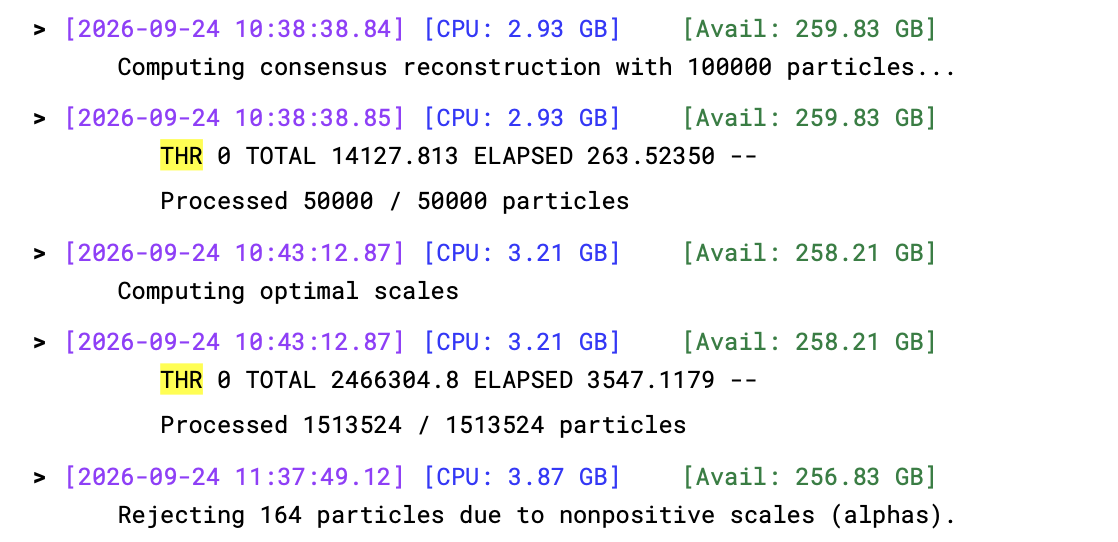
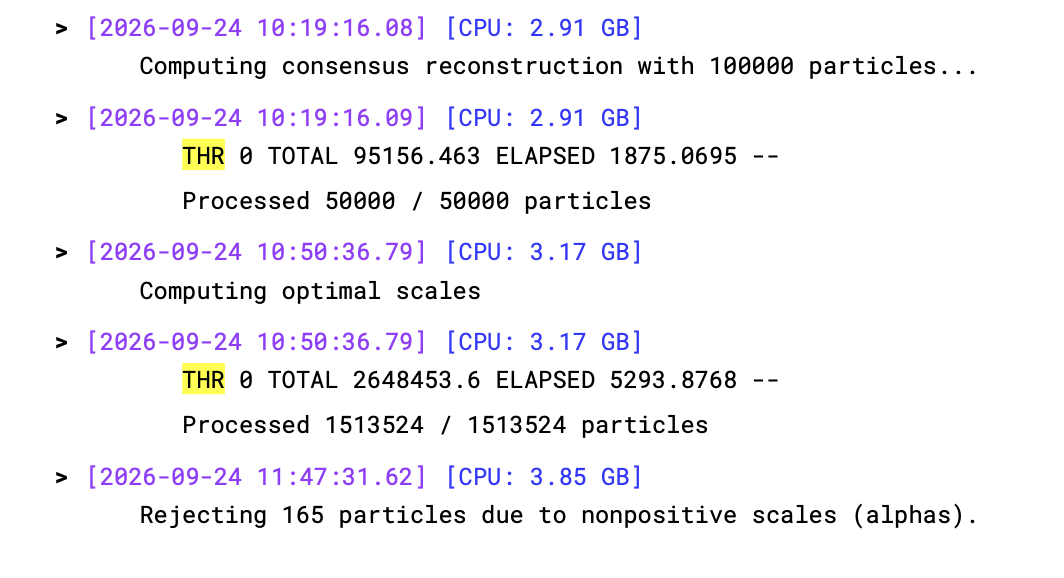
Both had same job and same file system ( including scratch ) and everything is identical. Newer GPU cards takes about 6X - 7X more time than older cards for “Computing consensus reconstruction with 100000 particles…” Whole job is about 6-7X slow.
This step is limited by GPU or I/O or CPU any help is resolving this would be great as many users are affected by this. If you need any father clarification please let me know. Thanks
Thanks @Rajan for your question. There seem to be a few potential nuisance variables involved here that could affect the results. I am listing them here in rough and preliminary order of significance; the list might be incomplete. It would be good to clarify and, potentially, eliminate them in order to isolate the relevant variable.
Is the 1080Ti node part of a “node” lane, the L40S node part of a cluster lane? Please can you post the output of the command cryosparcm resources
What are the filesystem types for cache and project directories? Do the network paths and bandwidths (adapters and intermediate switches) differ between the two nodes?
What are the outputs of these commands on each node in the comparison:
This might be relevant if SLURM is configured with cgroup constraints on RAM and CPU resources, whereas a non-SLURM job would not be constrained in this way.
Have you tested and confirmed that this non-local cache actually improves particle read performance (versus reading particles directly from project directories)?
The [always] setting may lead to unpredictable performance problems. The effect of this setting may differ between nodes and may depend on external (other CryoSPARC or non-CryoSPARC) concurrent workloads. One may bypass this unpredictability with the [madvise] or [never] settings.