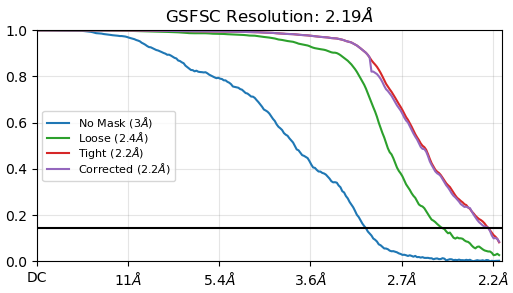
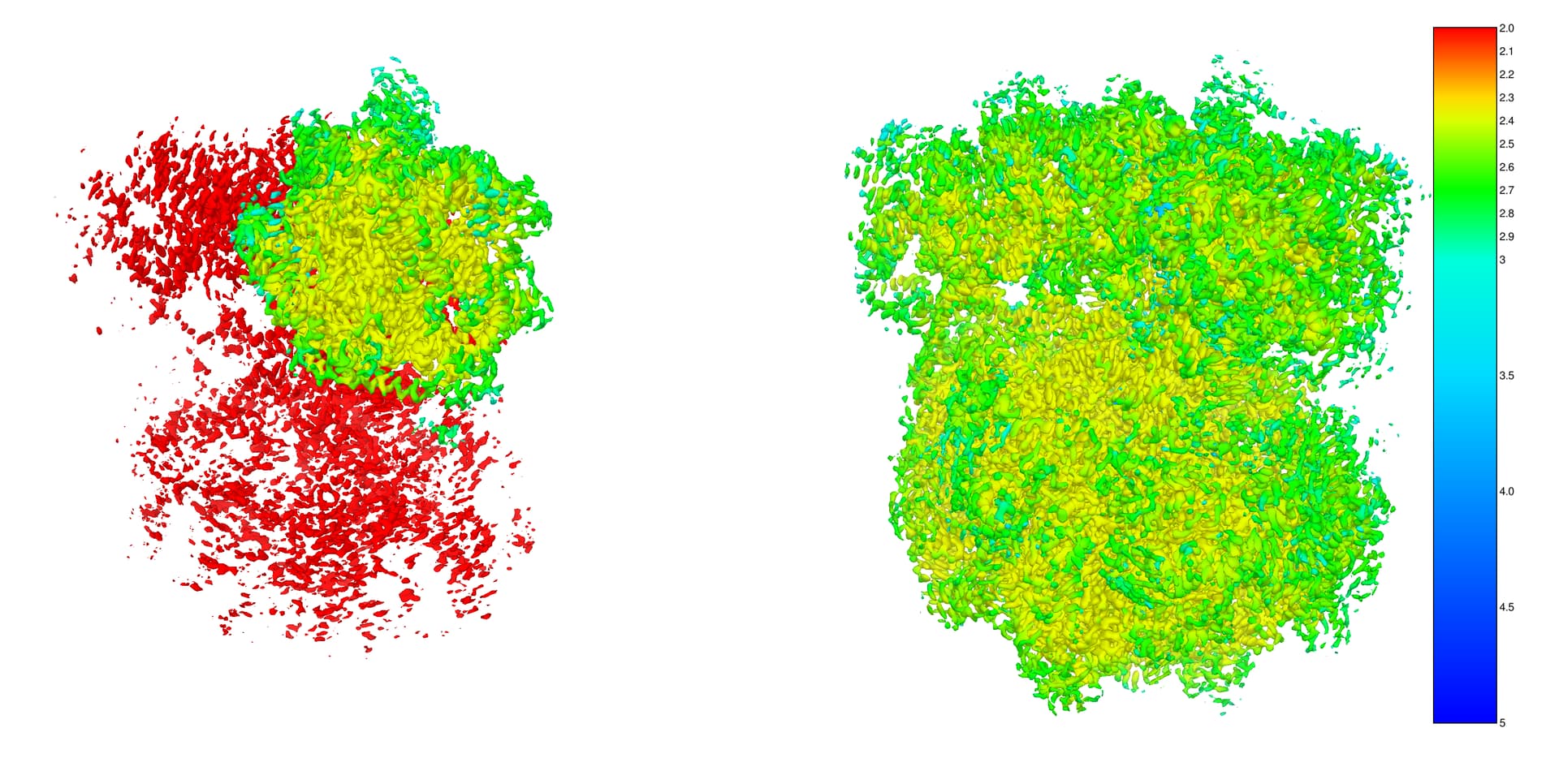
and this the resolution reported by the job is 2.19
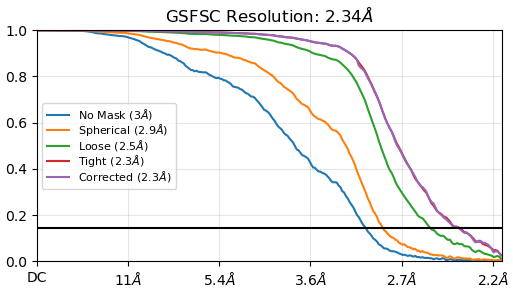
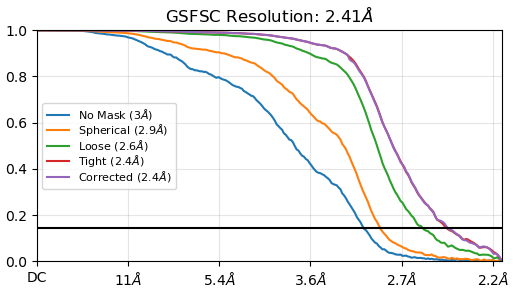
The local refinement did indeed improve the resolution of the domain because if i run the local resolution estimation job with the mask on my homo refinement, i get a resolution of 2.4 instead of 2.3.
Is the quality of the region of the map that you have locally refined improved in terms of its features?
I think this is the most important aspect of local refinement to focus on, to judge the actual gain, rather than the average resolution number that FSC plots produce.
For local resolution estimation using a FSC cutoff of 0.5 is standard practice. In a publication you could show the FSC plot from the local refinement job and then a figure showing the locally refined map coloured by its local resolution. You could also compare the local resolution of the region before and after local refinement to show the improvement. This should show readers that there is an improvement on the region due to local refinement
CryoSPARC automatically adjusts the mask to try to achieve the highest resolution possible. Sometimes this is desirable, sometimes it can cause problems. You need to get “eyes on” your map (both sharpened and unsharpened!) to decide whether you need to do any adjustments with a custom mask or adjust the default sharpening amount.
You would report the “gold-standard” (GS) FSC. The local refinement works slightly differently to homogeneous/non-uniform refinement in that it will work with the whole dataset from the start and you can use finer angular sampling - which for some samples (usually higher symmetry ones) can give large resolution gains!
Further, local refinement can be used to either refine the whole volume, with the fulcrum centred as with homogeneous/non-uniform refinement, or focus on a specific area (with a custom mask and change in fulcrum location). The latter usually results in a global decrease in resolution (as other areas being more disordered) but improved clarity in the region of focus - e.g. a flexible domain.
So you would report the global GS FSC (for the whole map) and a localised FSC if you did a focussed refinement on a specific region (perhaps also showing local resolution estimates - which are a separate job type).
This is where you need “eyes on”. It may pay dividends when trying to model build, if a region is less well resolved.
follow up question because it did not work for one smaller domain, and my question is what is the limitation ? is it below a certain % of volume of the complex it wont work or is it about the size itself ?
and even with a more limited complex the domain would still most likely be too small to study with local refinement ?
thanks once again for the discussion and the answers.
Hi @Yannlefrancois! To add to the great advice you’ve already received above, I want to note that the threshold you select during Local Resolution estimation (0.5 or 0.143) only changes the local resolution map – the global resolution calculation plots you posted always use 0.143.
As for your followup question, Local Refinement generally works best when refining a domain which is large enough to align and internally rigid but moves relative to the main bulk of the protein. Put another way – the domain looks the same in every image, but it might be in a different place. In general, conser size in kDa when guessing how hard a domain will be to align, rather than percentage of the total object, but when talking about Local Refinement it will depend a great deal on your sample, how much the domain moves, the quality of the images, etc.
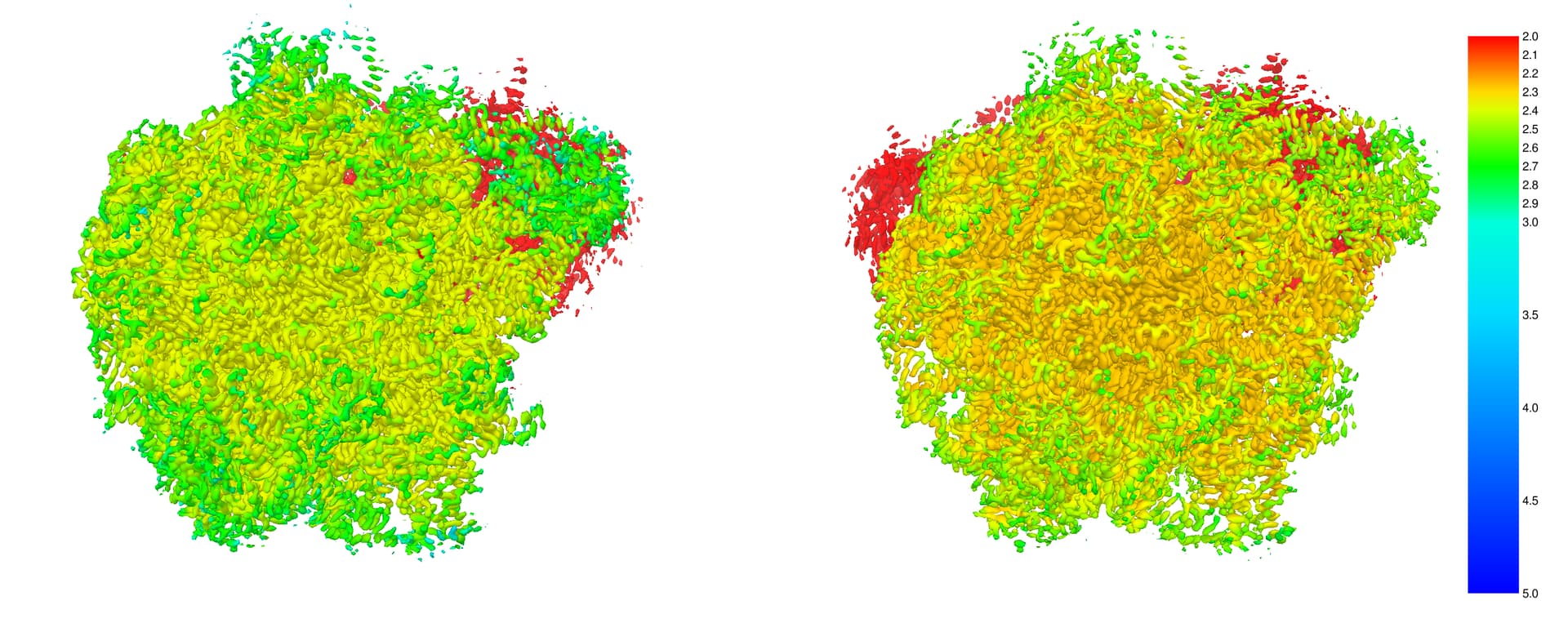
I have a question related to rendering of the local resolution and publication of such data. The region in red that is being blurred out is clearly outside the mask and is being given a “resolution” of 0 but yet the color legend from Chimera assigns a resolution value. How would one handle this when it comes to using this as a figure in publication? Would the author just state that the region is outside the mask and that it should be ignored? My concern is that this might be confusing to a reader that isn’t well versed in cryoEM. Is there a less “clumsy” way to present this?
Hi @jcheung! You’re right that the value is 0 because it’s outside the mask. You have a few choices for how to proceed here, depending on what you think communicates your results best.
You could re-run the Local Resolution job with a mask which covers the entire map at the contour you want to display. This may generate poor results, especially when looking at the fragmented/dusty region.
You could apply the mask you used in the Local Refinement job to your map in ChimeraX (volume mask {map} surface {mask}). This will set the region outside your mask to zero, so you can set your contour without the dust appearing. You should note that you’re showing a masked volume in the figure.
You could note that regions of the map with a resolution value of 0 in fact have no data, as you suggested.