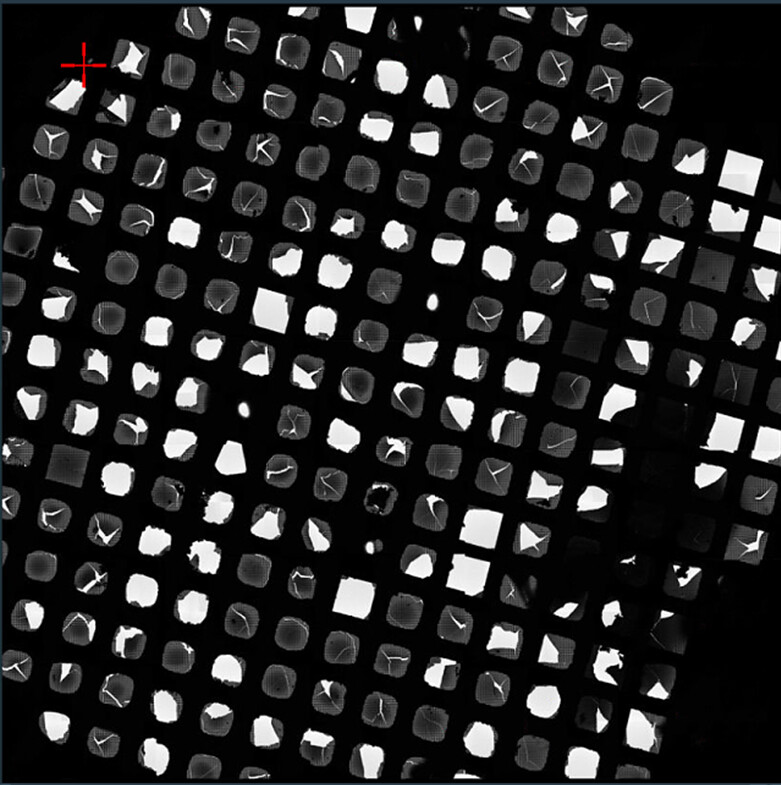
I’m currently facing an issue with ice puddles on my grids and would appreciate any insights.
Here are my grid and freezing conditions:
Grid type: Au200/R2/2
Glow discharge: 25 mA for 30 sec
Graphene oxide coating: 2 min
Humidity: 100%
Wait time: 30 sec
Blotting time: 1.5 sec
Despite these settings, I consistently observe ice puddles. It’s unlikely due to protein aggregation, as my sample is monodisperse. I also tested alternative conditions — for example, 15 mA for 25 sec glow discharge and increased GO coating to 3 min or without GO coating — but the puddles persist. Also, I tried different sample concentrations like, lower/higher, but nothing changed.
Has anyone encountered a similar issue? Which parameters should I prioritize optimizing to minimize or eliminate ice puddles?
This grid looks destroyed. When you say “graphene oxide coating 2 minutes”, I don’t really understand what this means - can you explain your procedure a bit more?
I would be less concerned about the ice puddles here and more about the huge cracks and lack of intact squares
Thank you for your comment, and apologies for the earlier lack of clarity.
Here’s my workflow: I first glow-discharged the grid, then coated it with graphene oxide, incubated for 2 minutes, and washed it with water before applying my sample.
I realize the large cracks on the grid are likely due to inexperienced handling, but what concerns me more is the consistent presence of ice puddles across all grid squares. Even in the intact areas, the puddles are significant enough to interfere with data collection.
We frequently have puddles, but often users want them (otherwise we have issues with ice being too thin). You could try adding a 2-10 second post-blot (“drain” on the Vitrobot) time, which can allow ice to spread more evenly across the grid after blotting.
However, I overall agree with @olibclarke in that if you improve grid handling skills, you will have many more good squares and that will allow you to get enough holes to collect on even if you can’t image the centers of the grid squares.
Is this a 200 mesh grid or are we only seeing part of it? If so, you can also try increasing to 300 mesh, which will improve the durability of the squares and also may change the ice dynamics.
Thank you for the suggestion. For a 2–10 second post-blot (drain) time, should I set the humidity to around 95%? Also, could the glow-discharge duration contribute to the formation of ice puddles?
Looks like most of the grid is visible… it’s been a while since I saw a grid that was quite that smashed up - definitely agree that improving grid handling is the first step.
95% or 100% won’t make much of a difference - the hygrometer isn’t that precise!
Agree w @rbs_sci . 90-100% makes no difference in our hands, and that’s what we always work at. Glow discharge probably won’t make much of a difference here, or at least it doesn’t for us.
Edited to add: In one set of tests I did, 0, 3, 5 s pre-blot time had no puddles, but they appeared at 10 s. This doesn’t make a ton of intuitive sense to me, but if you are desperate to get rid of the puddles you can try shortening the pre-blot time. We generally don’t ever go over 10 s pre-blot for SPA.
If you are using a Vitrobot then the parameter that I would vary is the blot force. Ideal blot force conditions will be different on each Vitrobot. Fix the blot time at 3 or 4 seconds. Set the humidity to 100%, I always start the humidifier first so that the papers have 10-15 min to get saturated. Glow discharge on these grids should be fine 1-2 min. But do check to make sure that the glow discharge is actually doing what it should be.
Graphene is not very hydrophilic so you may not be getting good spreading. GO flakes are better but not that much better in my experience. Layering a single sheet on graphene on top of the grids and hitting them with some ozone is the best way to make the sample spread well. That should reduce the puddling. You may not have access to all the equipment that is needed for this though.
Try first to optimize the blotting conditions, then take it from there.
I never add any drain time to any blotting. I tend to think that you are better off plunge freezing as quickly as possible to avoid denaturation. Just my opinion.
Thank you all for the helpful suggestions — they’ve been really useful.
Since my sample concentration is relatively low, I’m wondering: if I shorten the pre-blot time to 3–5 seconds, will that reduce how many particles enter the holes compared to a longer pre-blot time (25–30 seconds)?
Also, if I skip the graphene oxide coating and use only Au200/R2/2 grids, would a 1-minute glow discharge at 25 mA be sufficient to improve particle distribution within the holes?
Lastly, since I’m working with a weakly interacting protein complex (~600 kDa total) and low sample concentration, would it be worth optimizing the blot force as well?
Do you see any signs of GO on the grid? I’d make sure you can reproducibly add GO flakes that have good coverage without being too dense. You can assess this by looking at FFTs of images of just the GO-covered grid in a side-entry TEM. 1 GO flake = 6 spots, 2 flakes = 12 spots, many flakes = a bright ring.
I’d say try out different times and see. It can vary by sample, but we usually max out at a pre-blot time of 10 s (although we are usually looking at presence or absence of ice as opposed to particle distribution in holes).
I have never seen much of a difference in different Vitrobot blot forces once the pads are touching each other (After “tare-ing” the blot force by determining what blot force makes the pads just touch, I have done +0, +5, and +10 blot force and with aldolase they all looked identical to me, but it is a well behaved sample). But again, worth a try and if it is your magic ticket, it’s worth doing.
If you use gold foil grids, you will likely have different particle behavior because it is a different foil. However 2/2 grids will be very difficult to get any ice in there in my experience, particularly with a sample that is not very concentrated – gold foil grids have thinner ice and it’s hard to get any ice in larger holes. We usually do 2x the glow discharge for gold grids than we do for standard carbon grids, so that glow is probably fine. You can’t really over-discharge gold grids. With standard gold foil we usually see glow discharge as more of an on/off than a gradient that changes useful qualities of particle distribution, ice, etc. But again, your experience may vary. With our Leica we find that gold foil increases the puddling behavior as opposed to carbon foil grids and I think also continuous carbon grids, although I may be misremembering that last one.
Agree with @tlevitz. 200 mesh is more fragile which explains the torn squares. Switching to finer mesh (300/400) has been my go to for smoothing out “ice puddles”, then adding below CMC detergent. The pre-blot time is an interesting factor that I haven’t played with in a while and will try.