Hello,
I have a question regarding my cryoSPARC processing workflow.
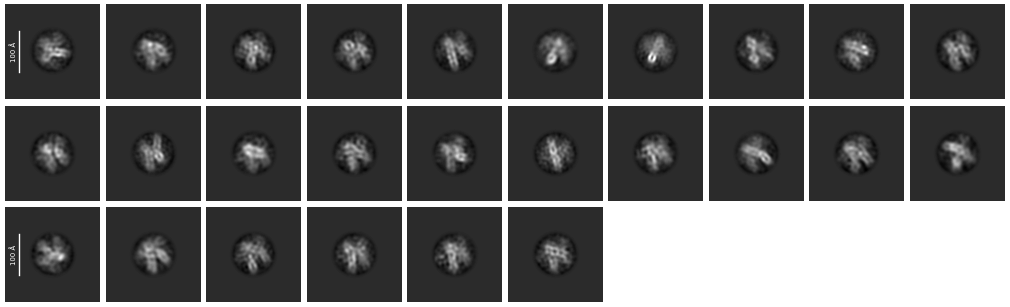
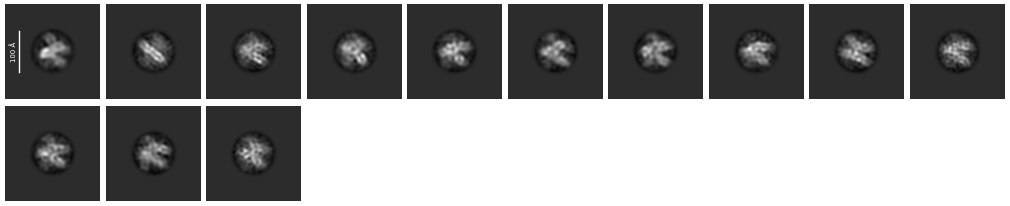
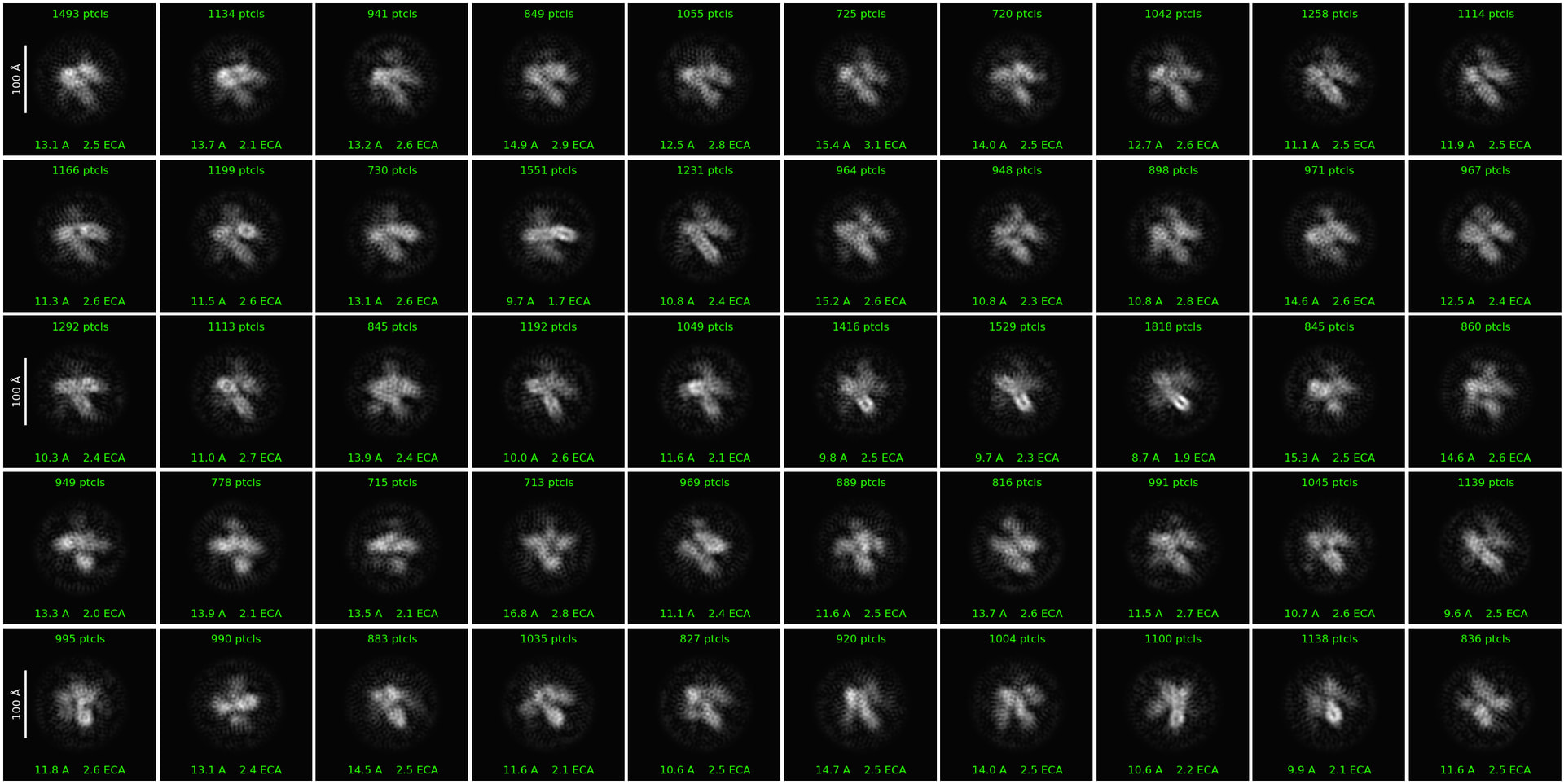
I initially obtained a good 2D classification with visible structural details. However, after selecting the good particles/classes and running another round of 2D classification, I seem to lose resolution and the classes become worse.
I’m not sure what could be causing this issue or what parameters I should optimize to improve the final resolution.
Has anyone experienced something similar or has suggestions on how to troubleshoot this problem?
Hi carole,
Can you give us a few more details here? How many classes and particles were you using in your initial 2D classification, and how many in your subsequent 2D classification?
Is the central part of these particles a micelle or nanodisc?
To me it looks like you have some serious flexibility/heterogeneity in your particles. Might be worth skipping 2D for now and running several rounds of het refinement with one “good” class and 4-5 junk classes from aborted ab initio runs. This assumes you have a large number of particles - which gets back to @tlevitz point above.
1 Like
Hi,
Thank you for your reply. Just to clarify the situation a bit more:
I am working with a 55 kDa protein composed of two domains, D1D2. Up to now, we do not have a cryo-EM structure for these domains, so they may be highly flexible and dynamic.
Regarding the heterogeneity, we know that this protein interacts with another protein of 17 kDa and induces dimerization and trimerization of the domains. Therefore, I think that on the grid we have different populations. The initial purpose was to study the trimers, so I performed SEC in order to isolate a single trimer population. However, it seems that dissociation occurs on the grid.
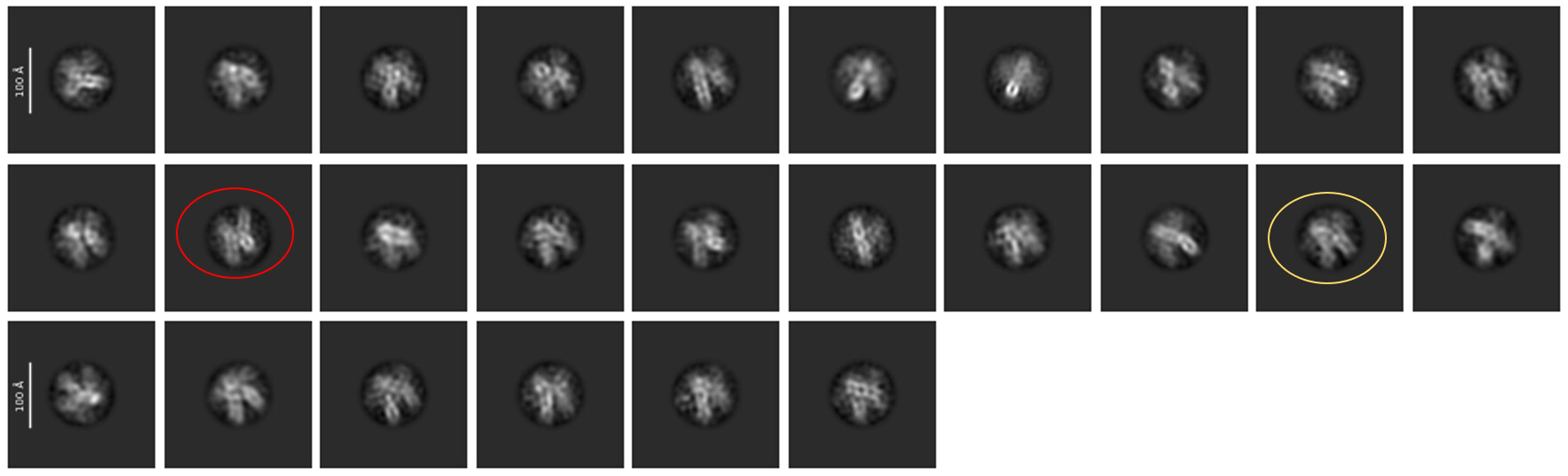
By fitting the CryoSPARC ab initio model with my model, it corresponds more to a 1:1 complex (a 55 kDa monomer with the 17 kDa protein). Moreover, from the 2D classification and the ab initio model obtained from heterogeneous refinement, I also identified a dimer model. As you can see in red, it is most probably the dimer, while the yellow corresponds to the monomer.
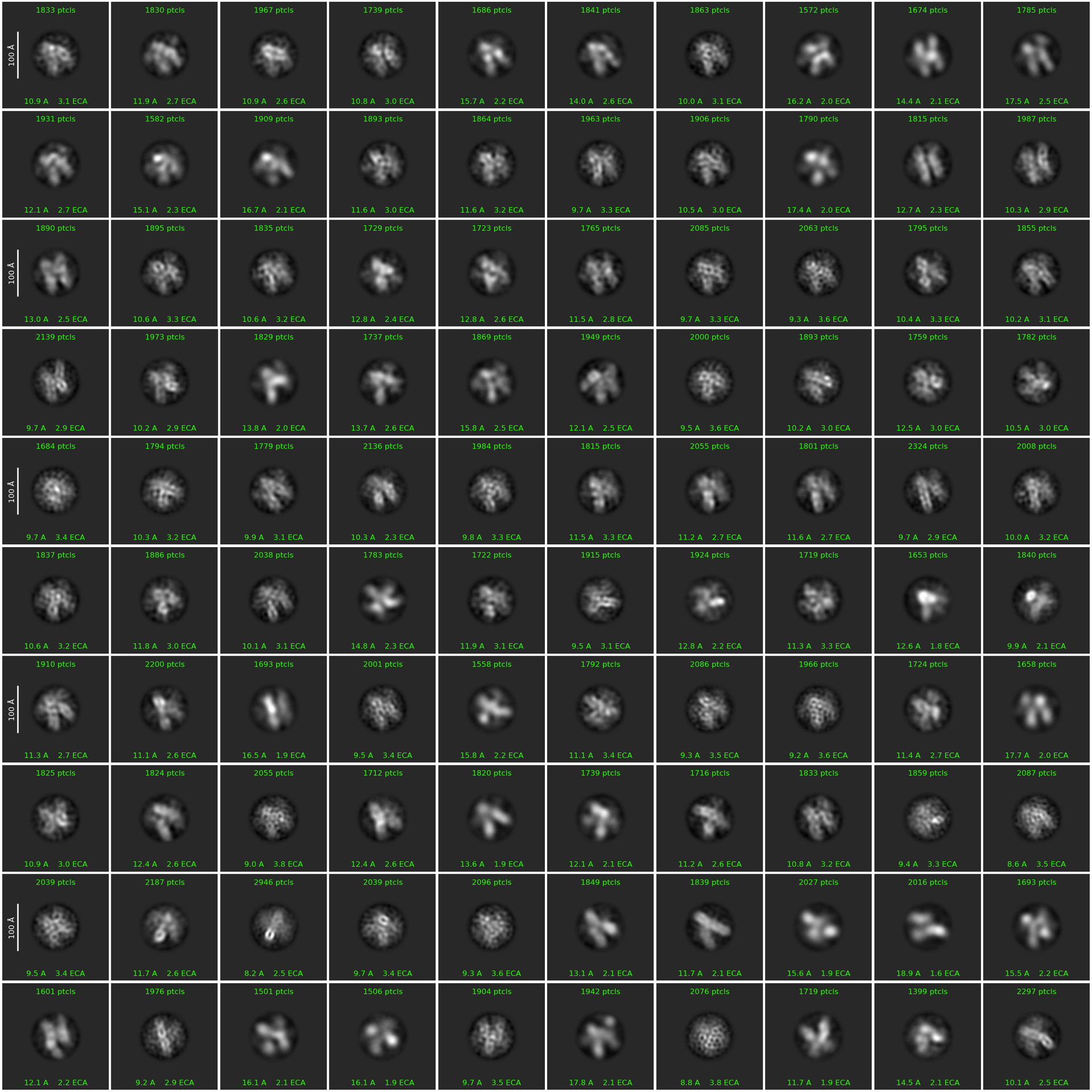
First, I extracted 301,551 particles. Then, after 2D selection, I retained 187,402 particles (I attached the 2D classification with 100 classes). After another round of 2D selection, I obtained the dataset shown in the first image I sent, containing 51,647 particles .
Finally, after performing another 2D classification on these 51,647 particles, I obtained these 2D classes (low resolution).
I hope this is clearer now.
Thank you!
Hi carole,
So, this is not terribly uncommon, depending on the number of classes you have. At some point, you will start seeing degradation in 2D class quality because of the number of particles per class. 50k vs 180k total particles definitely could cause this difference with the same total number of classes. Basically, two very similar classes may be combined into one class in your first 2D classification, increasing overall signal, whereas they may be two separate classes in your second 2D classification, which separates them based on some slight difference (or noise) but then you have about half the signal (it definitely is a bit more complicated than this behind the scenes, but you get the idea).
Additionally, it looks like the middle 2Ds are perhaps a different extraction box size, or at least just some are windowed with a mask and some are not?
Generally speaking, 2D classification isn’t the stage in which you’ll be able to separate out super-high-quality particles from high-quality particles, and so if you are confident you’re getting rid of most of the junk, I’d move along to 3D jobs. But, if you want to compare the 2D classification right after selection to before selection, I would recommend decreasing the number of classes (while keeping everything else constant) so that you have somewhat close to the same number of particles in some of your biggest classes between the two jobs. If you want super good 2Ds sometimes doing a much smaller number of classes will increase signal to noise a bunch, although at some point you start combining classes that really are different.
Hi tlevitz,
Thank you so much for your suggestions and help! I will try reducing the number of classes in the 2D classification.