Helical refinement does not work though ab initio reconstruction gives a good helical structure

Hello,

I am working on a helical structure.
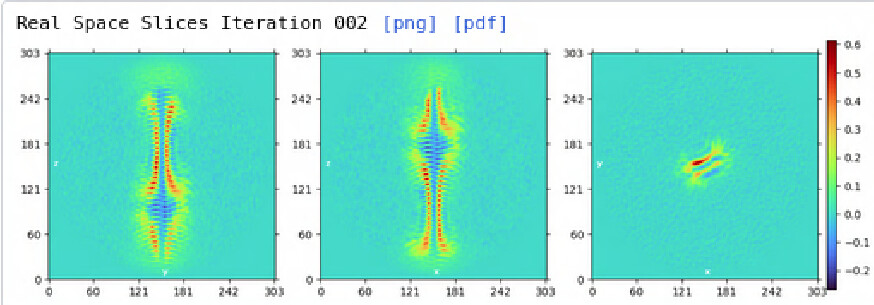
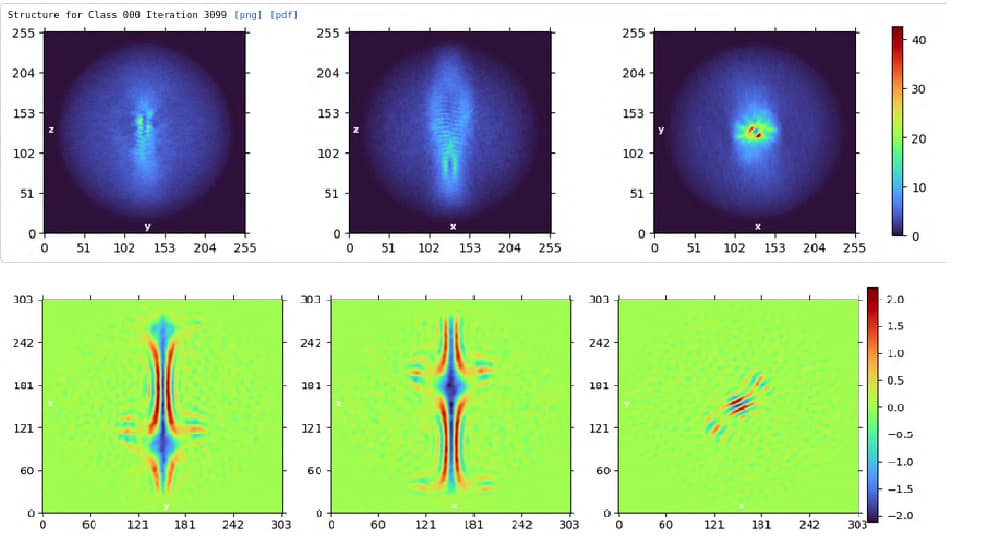
After ab-initio reconstruction, a twisted structure with ~4.8A-spaced ladder at the center of the structure was obtained (top of the image). From a 2d-classificadtion result, it was estimated that the twist is ~-7 degrees. Using these values as initial inputs, helical refinement was performed. However, it did not give a realistic structure predicted from the ab-initio reconstruction result (bottom of the image). The result is quite artificial and far from what I assumed to be.

The parameters that I changed for the helical reconstruction are as follows (The other parameters were not changed).

helical twist estimate: -6.9 degrees
helical rise estimate: 4.8 angstroms
minimum helical twist to search over: -8 degrees
maximum helical twist to search over: -6 degrees
minimum helical rise to search over: 4.7 angstroms
maximum helical rise to search over: 4.9 angstroms
do high-resolution noise substitution in FSC computation: yes

I also tried homogeneous refinement but it did not work either.

Are there any ways to solve the problem?
Or, is it intrinsically difficult to perform helical reconstruction because the ab-initio reconstruction result is not so perfect?

Thank you for listening, and hope to get any hints or comments.

NY
Hi @cryosparc_NY

Your ab-initio map looks promising. Hopefully we can help you get the most out of your data. It appears, from the ab-initio model that you are attempting to reconstruct an amyloid fibril. If this is the case, there was a recent publication and discussion forum post related to reconstructing amyloid fibrils in CS.

Looking over your parameters, its possible that they are too narrow of search extents for rise and twist.

Additionally, how extensively did you clean the particle stack in 2D-classification? What were your parameter choices for ab-initio reconstruction?

Best,

Kye

1 Like

Dear @kstachowski, CryoSPARC Team

Thank you for your kind response. As you suggested, the structure that I am trying to construct is an amyloid intermediate which is not matured yet.

The ab-initio reconstruction parameters are as follows:

Window dataset: 0.85-0.99
Maximum resolution: 2 A
(The other parameters are left unchanged)

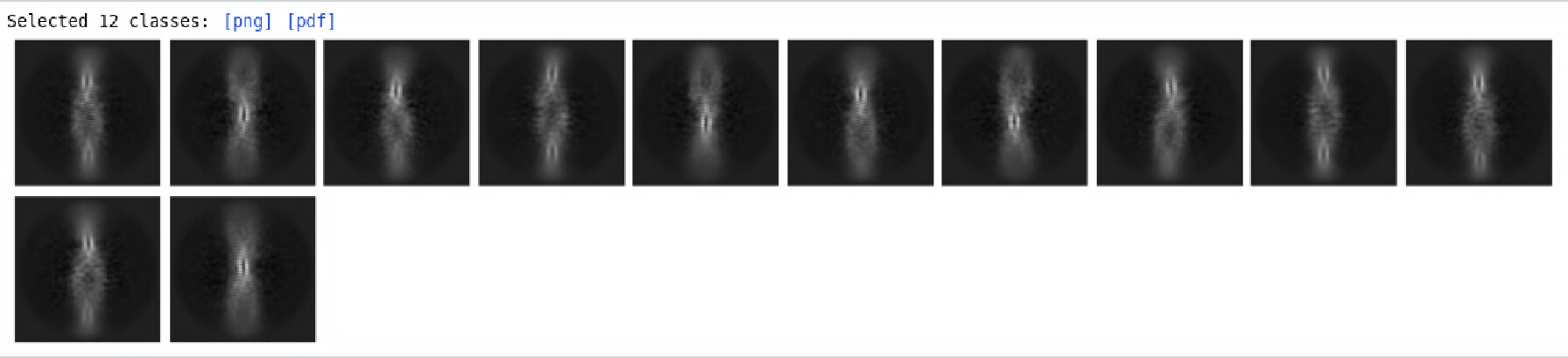
To show the 2D class qualities, I have uploaded 2D class results here.

I found a parameter that might be a key for helical reconstruction, that is, “Initial low-pass resolution“. I set the parameter to 4.5 A, so that the beta-sheet repeat can be referred for the helical reconstruction process.

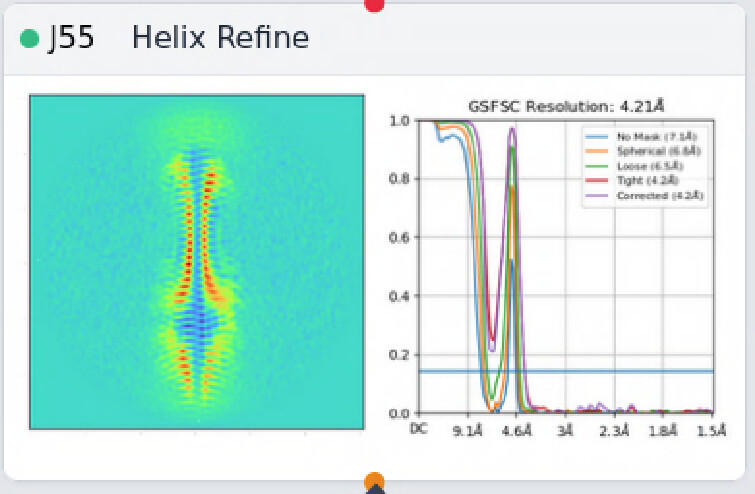
As a result, as I show here, helical reconstruction was partially successful, obtaining helical twist with a clear beta-sheet repeat.

Here I show the parameter used for the helical reconstruction.

Window dataset: 0.85-0.99

Helical twist estimate: -7 deg

Helical rise estimate: 4.8A

Helical twist search range: -7.5~-6.5 deg

Helical rise search range: 4.7~4.9 A

Initial lowpass resolution: 4.5 A

Maximum align resolution: 3 A

I set the twist and rise search ranges because these values could be roughly determined from the 2D class images.

However, the reconstruction result does not still seem perfect, because the FSC curve largely bumps without mask, and even after applying the masks, the bump still exists. Moreover, the resolution is still low, which was not able to be improved with homogeneous refinement. So, I guess something is still wrong.

Thank you for kind attention!

NY

Hi @cryosparc_NY , for helical structures, the Fourier space is not filled with information everywhere : instead, it is confined to layer planes (in 3D) / layer lines (in 2D). Outside those planes/lines, Fourier coefficients should be zero. For an amyloid structure, there is usually a concentration of signal near the equator in the Fourier transform, as well as at and near the 4.8A layer line. Hence, when you calculate the FSC for a helical structure, many correlations will be calculated between “nothing” and “nothing”, hence the bumpiness. This is true for all helical structures, however, depending on the helical symmetry, the Fourier space is more or less sparsely filled (layer lines can get very close to each other), and therefore this bumpiness is not always observed.

Best

Ambroise

1 Like