I am having difficulty distinguishing real particles from carbon background and noise in my cryo-EM micrographs, leading to unreliable particle picking. I have already applied micrograph denoising and performed manual picking, but I still cannot confidently identify my complex (a 180 kDa trimer). Could this be due to poor micrograph quality or insufficient particle concentration? For context, I purified the complex by SEC, confirmed its integrity and purity by mass photometry after crosslinking, and applied it to the grid at 0.1 mg/mL.
1 Like
Can you post a sample micrograph (denoised & not denoised)? At 180kDa it should be obvious if it is there
1 Like
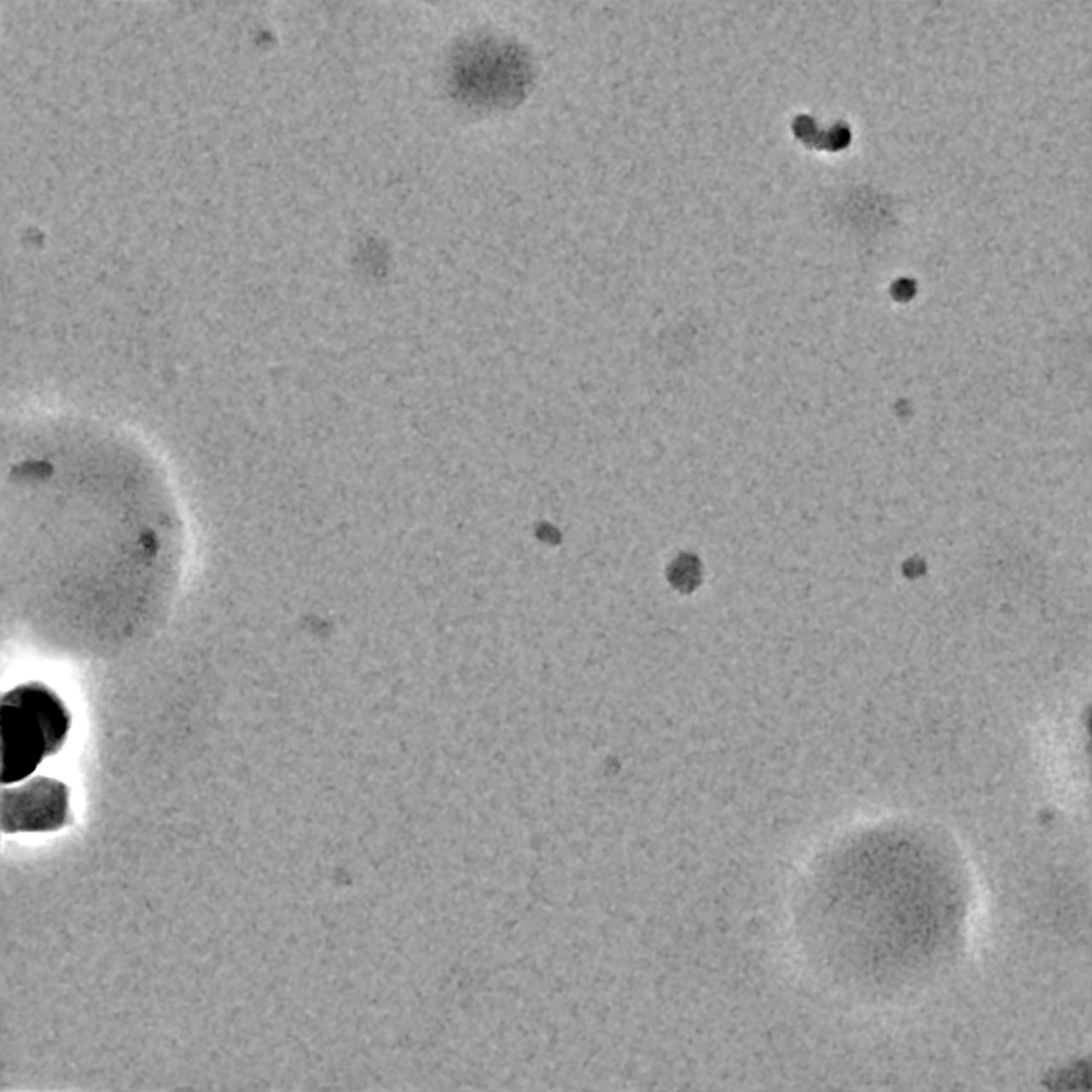
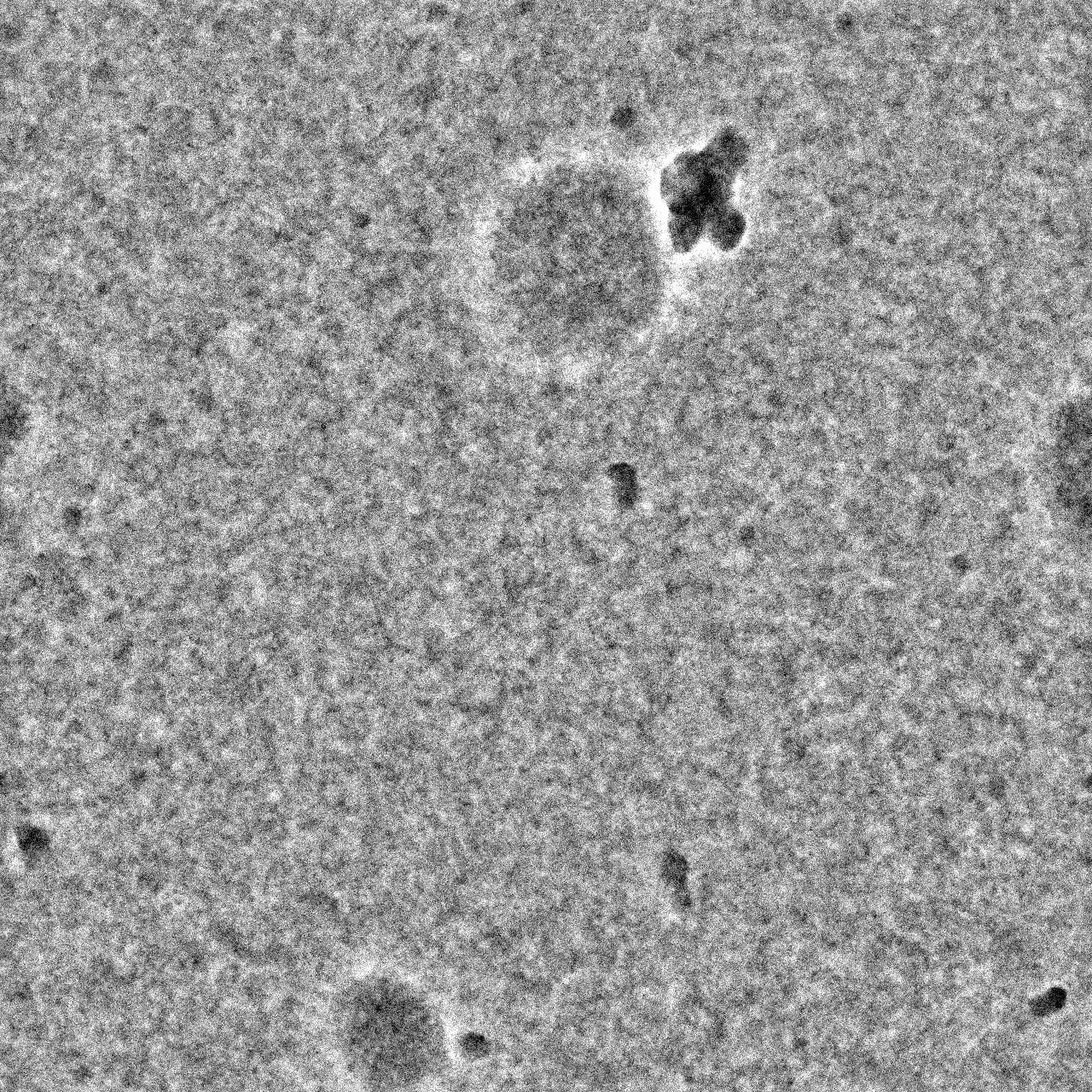
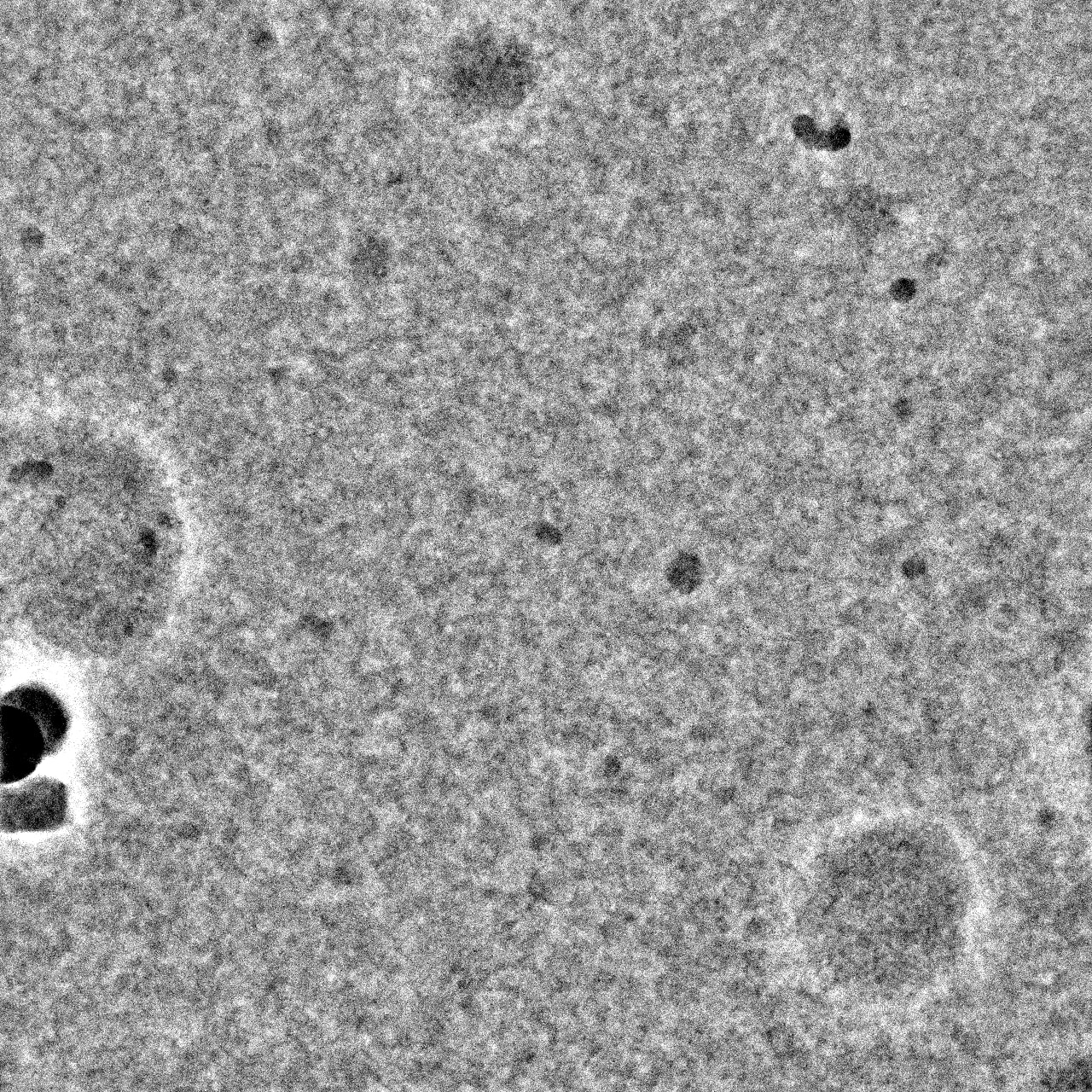
Nothing obvious there I’m afraid - you may need higher protein concentration?
I agree that it is almost certainly a concentration issue based on your micrographs, which look fairly empty minus the junk. I usually tell my users to start at around 2 uM complex and go up and down from there – for a 180 kDa complex, 0.1 mg/mL is 0.5 uM, so you have a way to go. Unfortunately, cryo-EM concentrations do not scale linearly, so a 4x increase in concentration will not generate 4x the particles. Having too many particles is an easier problem to solve than too few, so I often encourage for starting to try to screen up to 8-10 uM if possible in addition to other concentrations. Detergents also lower apparent concentration and will require you to bump up concentration even more. Good luck!
Edited to add: if your protein absolutely can’t get up any higher, you can try doubling the sample application (apply protein, blot, apply more protein, blot again, plunge). Blotting is a process that concentrates sample, so you will end up with more sample on the grid than if you apply and blot once.
2 Likes
Thank you so much for your help! I tried to manually pick particles that look similar to my model. Do you think they are false picks? Please find attached the 2D classification after manual picking.
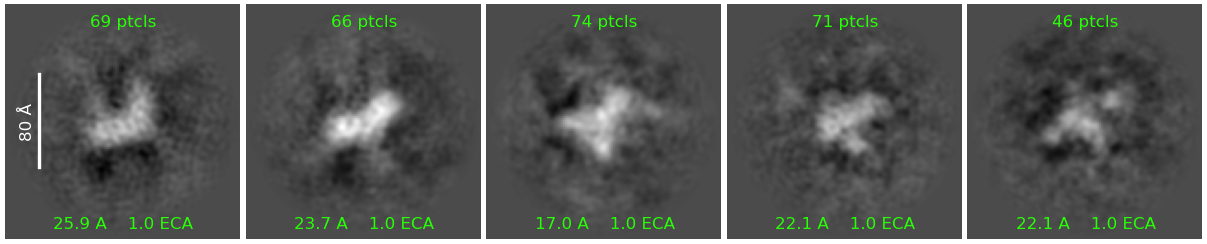
Hard to say, you have so few particles and they could be noise or they could be real but just very sparse. I would recommend that if you are this hard-pressed to find good particles, just start over at the grid preparation stage. You won’t be able to answer any biological questions with the number of particles you have in this data set, even with a lot of micrographs.
Take a look at this new biorxiv paper (Balanov et al) (or the original einstein-from-noise paper) for related caveats about any process, including manual picking, that can introduce bias. Your best bet to avoid bias is to start with blob picking on good micrographs and get some good 2Ds from there (with or without subsequent template picking).
1 Like
I would recommend going and having a look at the raw particle images. These are only a few hundred images so looking at each one to see if they are reasonable or not would be informative and not too difficult. You can use relion_display with some amount of lowpass and highpass filtering. The other option is to look at them in the denoised micrographs.
1 Like