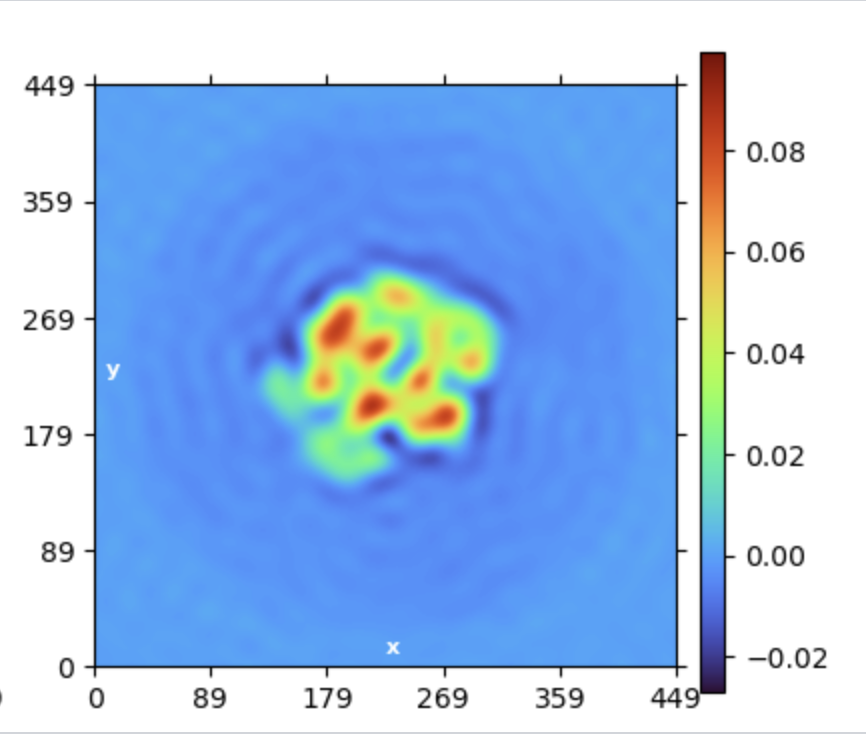
I’m rather new to cryo-EM so bare with me, I’ll try to make this as straightforward as possible. I am preforming helical refinements on a filament dataset. That sentence is a bit misleading though because I am actually trying to combine 2 different datasets (same pixel size, same exact microscope) that were collected about a month apart but am getting results that do not make sense when I try to perform a helical refinement job on the particles. I have the particle stacks from each dataset, that were extracted independent of one another, and have cleaned junk particles out of each particle stack independently. When I go to add both particle stacks into a helical refinement job and set the “Maximum symmetry order to apply during reconstruction” greater than 1 I get results I do not understand. See pictures below.
If the “Maximum symmetry order to apply during reconstruction” is set to 1, the “Real Space Slices” look odd (similar to picture above) at early iterations in the job (see below), but ultimately I get a decent looking map at the end of the job .
The upstream processing prior to helical refinement (i.e., particle picking, 2D classifications, filament tracer, junk detector, extract from micrographs, ab-initio, hetero refinement (to remove junk particles)) all seem to have worked well and have given me results that look correct. Which leads me to believe there is an issue combining the particles for helical refinement despite the same microscope being used to collect the datasets.
Has anyone had similar issues with combining particle stacks and performing helical refinement jobs?
If the datasets were collected a significant time apart, and the preps were different, it’s possible that you’ve got slightly different helical parameters present. Without helical imposition, this doesn’t show up so well, but when trying to impose (helical) symmetry it doesn’t work so well.
It’s more likely, however, that you’re using helical parameters which do not fit so well (i.e.: twist/rise is wrong). Try using symmetry search utility on the good (asymmetric) reconstruction.
I have some responses to your questions, updates, and further information which may help to diagnose the problem.
The datasets were collected about a month apart but are the same grids that were collected on. So I don’t think its a grid/prep problem.
The helical parameters are well known for this filament, and I confirmed the parameters (rise and twist) with my colleague who is very knowledgeable regarding the filament biology. I do not think this is the issue either.
In terms of the angular distributions, is this graph what you were asking for?
Now, I have done some further tinkering with parameters and discovered that the problem is dataset specific in regards to adjusting the “Maximum symmetry order to apply during reconstruction” parameter in the helical refinement job.
To explain further, the particles from the first dataset can be loaded into a helical refinement job and the maximum symmetry order value can be set from 1-9 and the job will produce a nice map. With the second dataset, helical refinement job can be run without setting the maximum symmetry order parameter (which will default to a value of 1 in that case) and the map will look fine. As soon as the maximum symmetry order parameter for the second dataset is increased though, I get the sorts of results that were in my initial post. This tells me it is a dataset specific problem and is related to the “Maximum symmetry order to apply during reconstruction” parameter in the helical refinement jobs. But I don’t know what the issue is for that specific dataset. Does this point to a parameter I need to adjust or something I may be overlooking?
If a month apart, it might be ice buildup on the second grid lowering general quality of the data.
OK. You weren’t explicit on whether this was novel or already well understood.
Yes, thanks. OK. no obvious orientation preference there - do the first and second datasets look similar in terms of distribution?
What sort of resolution are you getting just from dataset 1? If you used filament picking, CryoSPARC should automatically select the best symmetry order to impose (also, ab initio is not really necessary for helical work, as the helical refinement mode can generate its own initial model).
Sorry for the delayed response @rbs_sci and community,
I have figured out that the issue relates somehow to the the dynamic mask threshold. I do not understand why this is the case, friends who are better at cryo-EM than me do not either, but I was able to fix this two different ways which lead me to think it has something to do with the dynamic mask.
First solution was to change the dynamic mask threshold parameter. I adjusted it based on the scale next to the “Initial Real Space Slices” output from the first iteration of an earlier failed helical refinement job. I set it to the maximum value on the scale, in my case it was 0.08 (for example see picture below). The helical refinement job worked perfectly with a higher symmetry order than 1 after adjusting this parameter.
A second way I found to make this work was by rerunning the helical refinement job with symmetry value of greater than 1 but using the initial volume from the helical refinement job where the symmetry had been set to 1 as an input. My friend thought this also suggested it had something to do with the dynamic masking.
To briefly respond to your questions in the last post, the datasets do look similar in terms of the particle distributions. Also, I was getting about 2.3 A from just dataset 1 (now that I got the jobs to work with higher symmetry order value I have subsequently achieved a much higher resolution). I did use filament picking but was unaware that CryoSPARC would select the best symmetry order to impose this is good to know for the future! And I was was also unaware that the ab initio was unnecessary, I will take note of these helpful insights…
Ultimately, I do not know why these changes worked unfortunately, but I wanted to update this thread in case anyone else may be helped by this later on.