Recently we have collected few datasets from a Titan Krios G4 Cryo-TEM equipped with Gatan K3 detector. The collection was done in counted super resolution mode, with binning 1 and the physical pixel size was kept at 0.846 angstrom/pixel. During collection the particles were seen to be well distributed. While analysing the datasets using CryoSparc, we are facing some problems. While importing datasets, keeping 0.85 angstrom as pixel size, we are getting stuck at the patch motion correction and patch CTF steps continuously. Unusual patch CTF are getting generated, leading to abnormal 2D classes, and no features are visible even after multiple iteration. We’ll appreciate if we get suggestions on how to process these datasets collected in counted super resolution mode with binning 1 and pjysical pixel size 0.85 angstrom.
I’m not sure I’m reading this right, but if your physical pixel size is 0.846 and you import super resolution movies, they should be imported with a pixel size of 0.423 Å/px. If you imported superres movies without providing the superres pixel size, that would lead to wrong CTF estimation. Are your movies 11k x 8k or 5.7k x 4k? What was the magnification on the scope?
If the pixel size isn’t the issue, please post example plots and images of CTF estimations and 2D classes. An example of a micrograph is also helpful for troubleshooting.
When I’ve collected superresolution on a K3 I would put the raw pixel size as (in your case) 0.423 Å/pix and then for motion correction the Output F-crop factor should be 0.5
Thank you for the reply.
The micrographs we’ve collected are 11k x 8k in dimension. The magnification of the microscope was 105kX. I am attaching snapshots of the motion correction & CTF estimation for your reference. We have tried importing the movies at 0.425 angstrom pixel size. Can you also suggest the appropriate pixel size for import also? The header file of the collected micrographs says it is 0.846 angstrom (maybe the physical pixel size).
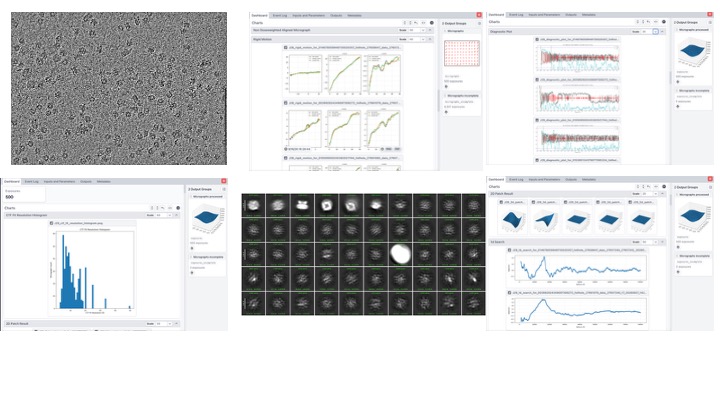
Thank you for the reply. I have done the motion correction with the Output F-crop factor 1, when imported at 0.425 angstrom.
Hi @Ankur2026 , I can definitely see particles in your micrograph but the 2D classes do look odd. Could you please share the following information so we can try to figure out what’s going on?
- The physical pixel size of the detector at this magnification (it sounds like this is 0.846 Å)
- The pixel size of the movies (it sounds like they were collected at superres, so 0.423 Å)
- The pixel size you entered in the Import Movies job
- The value you entered for the Output F-crop factor parameter in the Patch Motion Correction job
- One of the Patch CTF diagnostic plots, at full size
- The parameters you set for your 2D Classification job
- Your 2D classes, at full size
Thank you!