Small membrane protein with flexible fiducials and preferred orientation issue: Need help with particle-picking strategy?

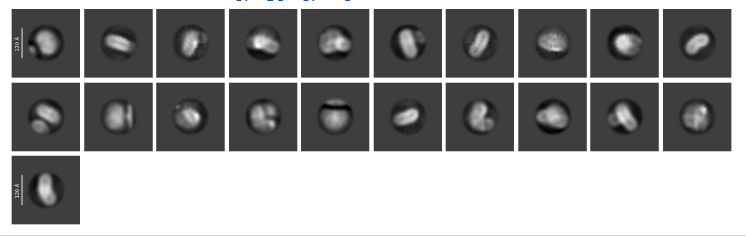
I am working with a small membrane protein (~78kDa) which has 8TMD’s and an extracellular domain which itself is ~40kDa which we initially thought can act as a fiducial by itself but still have an ALFA-Nb bound as well after flexible C-ter tail of this protein (Nb remains bound through purification strategy used here). My initial 2D Classification shows multiple side views and limited top views. What I am understanding here as potential problems might be: 1) Lumenal domain appears likely to be flexible and deosn’t contribute by acting as an ideal fiducial. 2) Since Lumenal domain and ALFA-Nb are probably same size, could my 2D classes be a mix of those containing only Lumenal domain vs others which can still potentially capture ALFA-Nb despite C-ter flexible linker or there is absolutely no chance ALFA-Nb can be seen here. I was concerned about heterogeneity here. 2) I may be experiencing preferred orientation issue here: I would like to ask experimentally what are best approaches to combat this issue? 3)I’d particularly appreciate advice on whether selecting rare views for an initial reconstruction and subsequent Topaz training is a sensible strategy here, and how to avoid introducing selection bias.

Many thanks!
Hi @mayabisw,

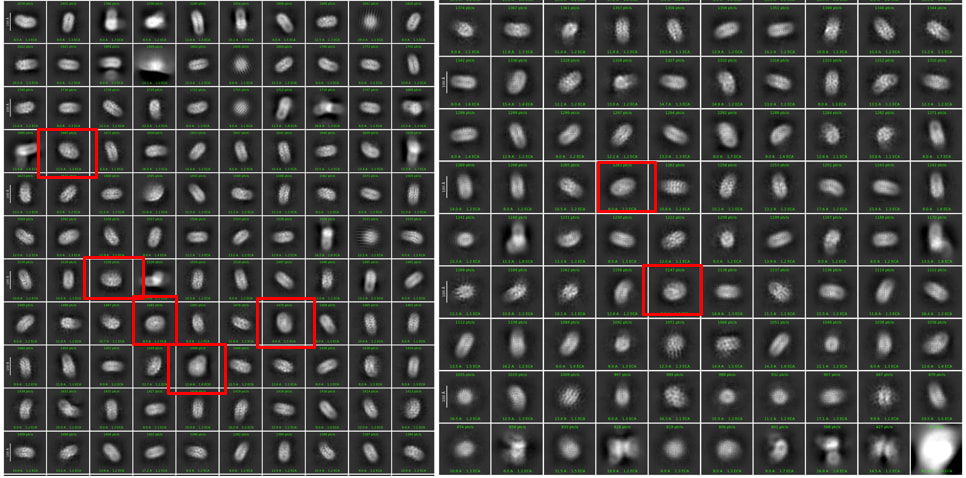
Your 2D classifications are good. I am able to see your ALFA-Nb. I do not think preferential orientation is here as I can see top and side views. Try a Ab-initio with high resolution cut off some 10 to 6 A; this is to remove the empty micelles and then feed the most probable class to homogeneous ab-initio reconstruction if your are using the new cryoSPARC 5.0 or use the HR-HAIR protocol if you have the old one. here is the link to protocol, if you have the old cryoSPARC. High-resolution ab initio reconstruction enables cryo-EM structure determination of small particles

Let me know if that makes sense.

All the best

I can recommend looking at the processing details from this work Structural and mechanistic insights into Streptococcus pneumoniae NADPH oxidase | Nature Structural & Molecular Biology (SpNOX: 46-kDa).

2 Likes

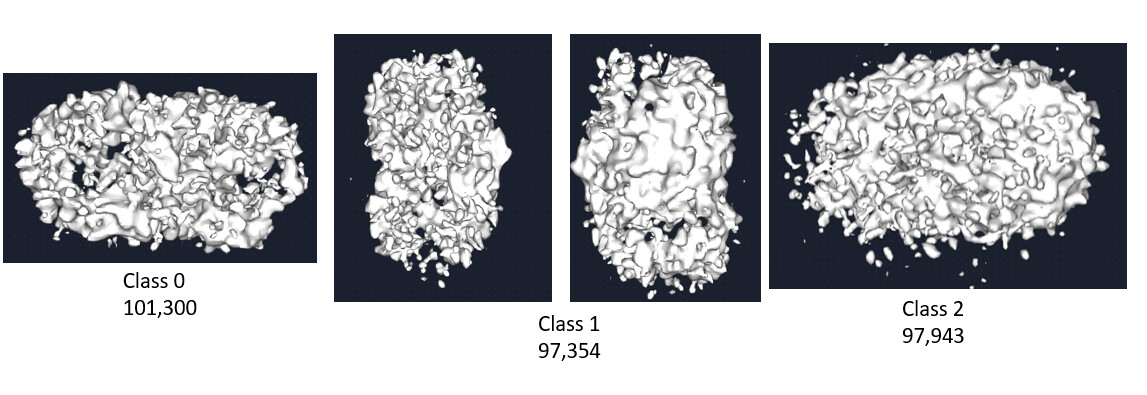
Hello @Das Thank you for the suggestions! I did a ab-initio with these classes and all 3 classes look kind of similar to me. I am having a hard time to rule out which are empty micelles vs the one containing protein. You suggested to use the most promising one of from these classes to do ab-initio homogenous ab-initio. I am using cryosparc v4.7 so will try using HR-HAIR protocol.

Thank you very much!

1 Like